Tuesday, June 22, 2010

Common Iora


Common Iora is a small sized greenish yellow bird that has a distinctive two white bars across its wings. A garrulous bird that keeps itself busy in the bushes of thick foliaged trees found at the edges of forests. During breeding season it is known to make some striking displays. A common bird but must say quite difficult to take a snap, the above has not come properly but as and when I am able to capture better pictures I intend to replace it. Till then the readers will have to do with these pictures!. These birds have many subspecies with the variations in the plumage.

Amy Lowell: We do not ask the trees to teach us moral lessons
Amy Lowell (1874-1924) was an American poet who was known for her contribution to Imagist movement (along with Ezra Pound). This i read about her in the net that i thought was interesting "She never attended college because her family did not consider that proper for a woman, but she compensated with avid reading and near-obsessive book-collecting". Apart from some excellent poems she is also known for her biography of Yeats.
This para from the preface she wrote to Sword Blades and Poppy seed

I wish to state my firm belief that poetry should not try to teach, that it should exist simply because it is a created beauty, even if sometimes the be
auty of a gothic grotesque. We do not ask the trees to teach us moral lessons, and only the Salvation Army feels it necessary to pin texts upon them. We know that these texts are ridiculous, but many of us do not yet see that to write an obvious moral all over a work of art, picture, statue, or poem, is not only ridiculous, but timid and vulgar. We distrust a beauty we only half understand, and rush in with our impertinent suggestions. How far we are from "admitting the Universe"! The Universe, which flings down its continents and seas, and leaves them without comment. Art is as much a function of the Universe as an Equinoctial gale, or the Law of Gravitation; and we insist upon considering it merely a little scroll-work, of no great importance unless it be studded with nails from which pretty and uplifting sentiments may be hung!

The Painter on Silk

There was a man
Who made his living
By painting roses
Upon silk.

He sat in an upper chamber
And painted,
And the noises of the street
Meant nothing to him.

When he heard bugles, and fifes, and drums,
He thought of red, and yellow, and white roses
Bursting in the sunshine,
And smiled as he worked.

He thought only of roses,
And silk.
When he could get no more silk
He stopped painting
And only thought
Of roses.

The day the conquerors
Entered the city,
The old man
Lay dying.
He heard the bugles and drums,
And wished he could paint the roses
Bursting into sound.

These lines from A London Thoroughfare. 2AM

Opposite my window,
The moon cuts,
Clear and round,
Through the plum-coloured night.
She cannot light the city;
It is too bright.
It has white lamps,
And glitters coldly.

I stand in the window and watch the moon.
She is thin and lustreless,
But I love her.
I know the moon,
And this is an alien city.

Happiness
Happiness, to some, elation;
Is, to others, mere stagnation.
Days of passive somnolence,
At its wildest, indolence.
Hours of empty quietness,
No delight, and no distress.

Happiness to me is wine,
Effervescent, superfine.
Full of tang and fiery pleasure,
Far too hot to leave me leisure
For a single thought beyond it.
Drunk! Forgetful! This the bond: it
Means to give one's soul to gain
Life's quintessence. Even pain
Pricks to livelier living, then
Wakes the nerves to laugh again,
Rapture's self is three parts sorrow.
Although we must die to-morrow,
Losing every thought but this;
Torn, triumphant, drowned in bliss.

Happiness: We rarely feel it.
I would buy it, beg it, steal it,
Pay in coins of dripping blood
For this one transcendent good.

The Tree of Scarlet Berries
The rain gullies the garden paths
And tinkles on the broad sides of grass blades.
A tree, at the end of my arm, is hazy with mist.
Even so, I can see that it has red berries,
A scarlet fruit,
Filmed over with moisture.
It seems as though the rain,
Dripping from it,
Should be tinged with colour.
I desire the berries,
But, in the mist, I only scratch my hand on the thorns.
Probably, too, they are bitter.

This poem “A Ballad of Footmen” is my favorite; it is a strong statement against war…I loved this “all bent on killing, because of their ‘of courses’”. Brilliant.

Now what in the name of the sun and the stars
Is the meaning of this most unholy of wars?

Do men find life so full of humour and joy
That for want of excitement they smash up the toy?

Fifteen millions of soldiers with popguns and horses
All bent upon killing, because their "of courses"

Are not quite the same. All these men by the ears,
And nine nations of women choking with tears.

It is folly to think that the will of a king
Can force men to make ducks and drakes of a thing

They value, and life is, at least one supposes,
Of some little interest, even if roses

Have not grown up between one foot and the other.
What a marvel bureaucracy is, which can smother

Such quite elementary feelings, and tag
A man with a number, and set him to wag

His legs and his arms at the word of command
Or the blow of a whistle! He's certainly damned,

Fit only for mince-meat, if a little gold lace
And an upturned moustache can set him to face

Bullets, and bayonets, and death, and diseases,
Because some one he calls his Emperor, pleases.

If each man were to lay down his weapon, and say,
With a click of his heels, "I wish you Good-day,"

Now what, may I ask, could the Emperor do?
A king and his minions are really so few.

Angry? Oh, of course, a most furious Emperor!
But the men are so many they need not mind his temper, or

The dire results which could not be inflicted
With no one to execute sentence, convicted

Is just the weak wind from an old, broken bellows.
What lackeys men are, who might be such fine fellows!

To be killing each other, unmercifully,
At an order, as though one said, "Bring up the tea."

Or is it that tasting the blood on their jaws
They lap at it, drunk with its ferment, and laws

So patiently builded, are nothing to drinking
More blood, any blood. They don't notice its stinking.

I don't suppose tigers do, fighting cocks, sparrows,
And, as to men—what are men, when their marrows

Are running with blood they have gulped; it is plain
Such excellent sport does not recollect pain.

Toll the bells in the steeples left standing. Half-mast
The flags which meant order, for order is past.

Take the dust of the streets and sprinkle your head,
The civilization we've worked for is dead.

Squeeze into this archway, the head of the line
Has just swung round the corner to 'Die Wacht am Rhein'.

Something I scribbled the other day

Leezzaarrd!!

Don’t know why they call a lizard a gecko
must be the way it sounds
short guttural dismissive
unlike blustery confidential leezzaarrd

Miniatures of Jurassic era
wriggles its nervous tail
wipes its tongue over bulging eyes
translucent gluttonous frame
like cheap chinese toy
haggled for in the crowded market
adorn the wall
the bigger one chased by smaller and smallest
frozen in a reverse evolutionary hunt
until the glue give away
and they tumble one after the other
and gamely wait to be arranged again.


Tuesday, June 8, 2010

The Ceylon Frogmouths

The Ceylon Frogmouth (now also referred to as Srilankan Frogmouth) is a nocturnal bird endemic to Western Ghats and Sri Lanka. Found in dense forests these are large headed birds that has huge frog like gape and large flattened hooked bills that is used to swoop on insects during night. Female are rufous while males are grey. These species sit upright on low branches during day, brilliantly camouflaged and look as if part of branch. It needs discerning eyes to locate even when few feet away. Absolutely amazing. They sat staring as if they think they are not been located, my guide a sensitive fellow asked me not to use flash (after my first click, the above pic) and disturb them. He reminded we are intruding into their sleep, i regretted my transgression. We took care not to make any noise and push the branches around as delicately as possible to get better view.

Of the 13 Frogmouth species found in the world, only two belong to India. The other is found in the Himalayas.

Reggie Siriwardena: Renaissance man from Sri Lanka

Reggie Siriwardena (1922-2004, later Regi, earlier Reginald) was one of the foremost Srilankan intellectual, critic, journalist, teacher, novelist, playwright and a humanist, and yes he also happen to write some excellent poems!!. When he turned eighty he wrote this line, the angst of violent nation that was loosing its promising young

scandalous at eighty years to walk
the earth where younger better people now are dust and ashes

Regi Siriwardena also collaborated in the introduction of a controversial new English literature syllabus to the consternation of the conservatives he included the lyrics of Bob Dylan's Blowing in the Wind and replaced Shakespeare. He was convinced of the unsuitability of Shakespeare at school level. Even for university students, he abolished Shakespeare for first year students. Once, while discussing English in the schools, he commented, This school Shakespeare competition has become the literary equivalent of the Royal-Thomian match. He also analyzed English and Sinhala text books for racist bias towards the minority communities. He noted and documented these prejudiced texts and highlighted that these promoted hatred towards the minorities in general and Tamils in particular. These texts published by the state were harming ethnic relations it was pointed out. As a journalist he covered the culture as also the international section (he wrote about astronomy for children too). He learned Russian and translated many works into Sinhala (noted for Anna Akhmatova and Pushkin).

His creations were hinged in torment of colonial humiliation of native culture and yearning for self respect for its people and universal aspiration. In his poem “Colonial Cameo”, he speaks of a father who made him read Macaulay and admire Napoleon and a mother who spoke only Sinhala. He remembers the day she took him to school and leaving she said “Gihing Enang” (sinhala) to a peal of giggles from his class mates (it was anglicized school). Reggie writes
My mother pretended not to hear that insult.
The snobbish little bastards!
But how can blame them?
That day I was deeply ashamed of my mother.
Now, whenever I remember,
l am ashamed of my shame.

Another poem from “Waiting for the soldier"

After the Roman army took
a soldier, in the midst of looting and raping,
stopped when he saw a Greek bent over
figures inscribed in the sand. Gaping,
the Roman watched his strange absorption
in that magic of lines and circles. He
(not looking up at the soldier) said," Move
With your shadow there it's hard to see"
The soldier hit him on the head, and so
Archimedes died. If, then, today
I turn more and more to this ordered world
of sixty four squares, to the mimic play
of forces in a field where nobody bleeds;
where in the intervals of the game my silent friend
won't annoy me by spouting racist drivel
or Marxist simplicities; if the chief end
of life at present seems to find
an infallible answer to the French Defence
(my opponent's favourite opening ), don't say
I am escaping. In a world without sense
one must look for meaning wherever one
can find it-if only, perhaps, for a day
or two. I know the Roman soldier-
in one shape or another-is on the way.

Continuing with his last poem that he wrote when he turned eighty these evocative lines
To have existed while the planet made
eighty revolutions round the sun is no
achievement, but I must confess I am
rather surprised to find myself still here.
It’s scandalous at eighty years to walk
the earth where younger, better people now
are dust and ashes,
who died of violence and had much more
to give -Rajini, Richard, Neelan
makes it embarrassing to be alive

In the same poem he writes

But I shouldn’t complain: to compensate.
I have acquired immunity to other
infections - post - modernism, for one.
And free verse, for another. I’m glad, too,
I never caught, as my late brother did.
The Sinhala nationalist flu. An early shot
Of Marxism, perhaps, took care of that.

Also some fun and premonition of his impending death

By time's mere flux, I am called to play the part
Of patriarch I am unfitted for.
But not for long, I hope. When the time comes,
Ajith, Prince of Obituarists, will write,
I know, a graceful piece - measured, as always,
And free of flattery or fulsomeness.

I don't believe there is judgment after death,
Or penal court of Yama: If there were,
And I were called to account, what could I say
In mitigation of sentence, but stammer,
"P-please sir, I tried not to be p-pompous ever,
P-pretentious, Sir, incomprehensible,
or b-boring". Would the judge pronounce severely;
"A frivolous trifler! He deserves no mercy,
I sentence him to fifty years of torture
Translating into Serbo-Croat the texts
Of Gayatri Spivak and Homi Bhabha!"


Friday, June 4, 2010

Ashy Prinia


A delightful little bird that can found in open field that has patches of bushes, it is a frequent visitor to gardens (atleast in the pre pollution era!) and can be seen on low uncertain flight from one bush to another. Small bird with long tail they have ashy brown upperparts and lower warm buffy. I have observed this bird many times but only recently able to take the snaps. I was at Art of Living (run by Sri Sri Ravishankar) on the outskirts of Bangaluru with the specific intention of capturing wildlife (did spot a well fed rat snake) walked up to the lake and around but couldn’t spot many birds, after the breakfast (they provide free food, I am a big fan of free food!!) while I walked across the garden in the front of the main mediation hall that I spotted Ashy Prinia busy searching food, it was a spectacular sight against bed of green grass. This was the only bird I could photograph in the whole trip but must say was worth it.

In my mid twenties I did travel around different ashrams in the country and so on, indeed I spent much of my time in Rishikesh (I still love that place, it is quite vibrant), I look for intellectual stimulation -what is referred to as Gyana marga and never been comfortable in Bhakti marga, the latter is where you find many charlatans. There are some genuine gurus too, though I was quite cynical of these people (famously Sai Baba, Mata Amruthanandamayi so on) some experience taught me that they have created a positive space and have considerably helped underprivileged people, so even if there maybe some minor transgression that get sensationalized by media sleaze I tend to look at the overall context of their contribution and find myself rather quite insignificant to even comment, it easy to find fault but think of millions of contended people. I have listened to almost all gurus those who have influenced me include Ramanna Maharishi, Swami Chinmayananda, Jiddu Krishnamurthi and most significantly Osho (quite a sharp fellow that one…what I liked about him was you can call him an adorable asshole!!. I haven’t met anyone so sharp and precise, one moment he could be on the pinnacle of enlightened thoughts the very next he comes out with some hilarious crap. It is juxtaposing these that made sense to me. A reminder that there is no all nice world, indeed such a world would be sickening. Intellectually I would rate Naipaul in the same category: unpleasant brutal truth told as brutally that it shocks and you are in awe, there is no compromise it is like a Zen slap. Clinical and profound).

I recall spending a night at Ramakrishna mission in Chennai in early 1990s (after doing some crap that I felt intensely guilty about), mylapore was such a beautiful place those days (now it overruns with vehicles and barricades). I carried a copy of Bhagvad Gita (with interpretation by Chinmayananda) when I landed in Delhi and would refer it quite often. An old man (the head of institute I used to visit to take occasional classes in evening at Karol Bagh) had a heart attack and was prescribed bed rest; I gave the copy to him. I was free!!.


I wrote these on the way back from recent visit to Western Ghats…

The dawn

I started the day early
and visited the trees
the birds were there
so were the bees.
The chill in the air
doubled the mirth
the eastern sky flare
gave out the joy
that the clouds carry
in little knots.
Not a penny
not a diamond
can the amazement buy.

Monday, May 31, 2010

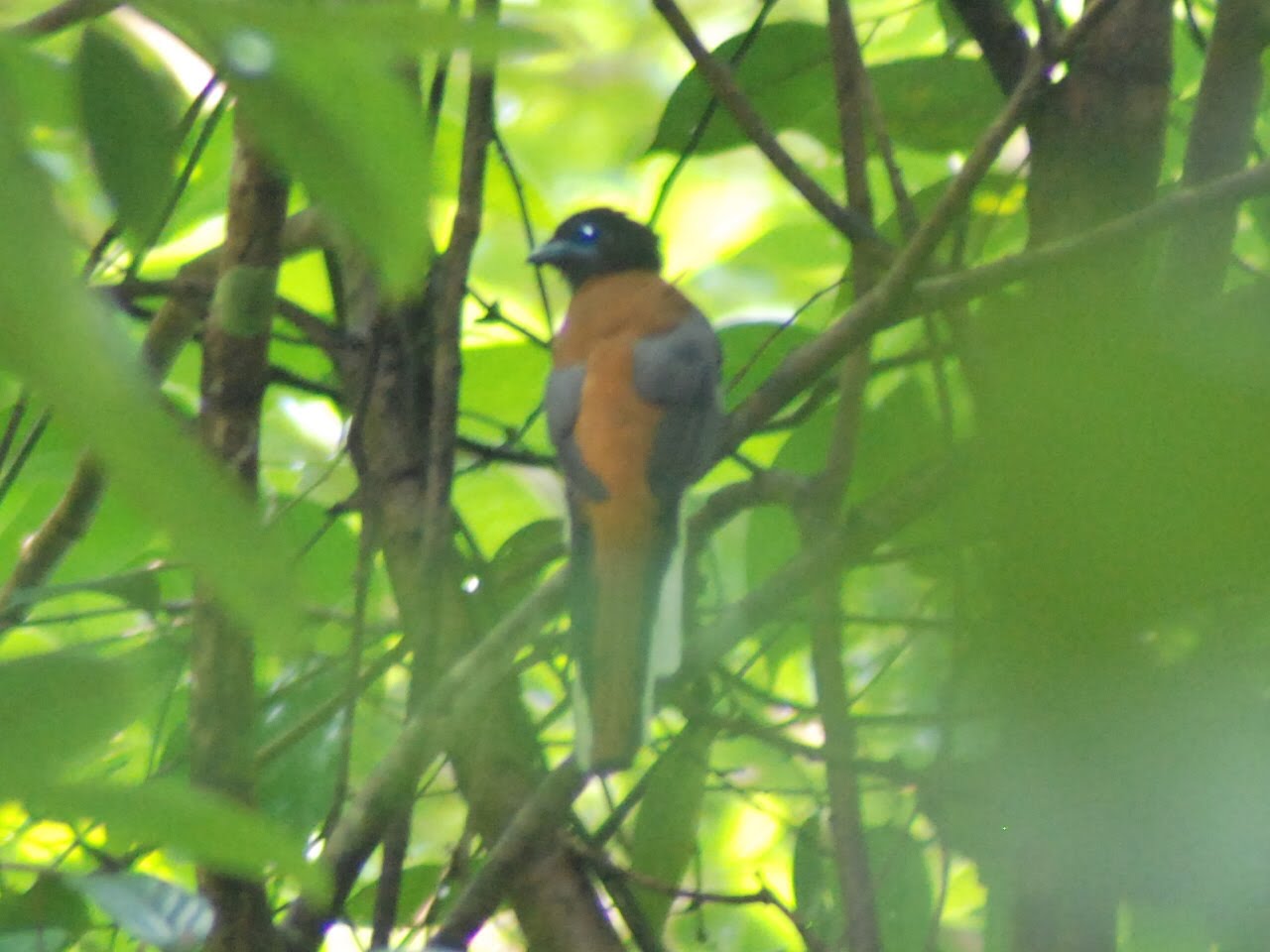
On Trogon trail

It was one of the thickest forests still humid from night rain the heavy forecast sky had made the noon eerily dark add to it an information from the locals that king cobra was spotted on the very vicinity where my bird guide and me where in hot pursuit of Malabar trogon. A dull single tone call had alerted us, following the sound, intermittently waiting for it to repeat and adjusting our path through the undergrowth (also sucked by leeches and getting a bleeding cut on head from an ominously thorny branch-must say the omen was missed!!) we finally got the glimpse of the elusive Malabar Trogon. This bird has a peculiar defense mechanism of allowing the duller side of it to the observer and keeping still, they can like owls turn their face 180 degrees and they sit as if hunched, the moment it sense the intruder it flies to nearby branch facing the other way and so we followed, it was as if we were being led, and then it hops to the further branch. It was getting quite tiresome after an hour I declared it is futile and next to impossible to get the front view pictures but my guide was an optimistic fellow and some encouraging words we continue the chase but eventually it was spoiled by group of happy noisy hornbills.

Malabar Trogon has black head that is separated by a white ring from the bright crimson underside, the back is dull chestnut, black wings and serrated tails. These birds live exclusively on insects. They have heterodactyl toe (backward toe) arrangement and like woodpeckers can be seen clinging to branches when foraging for insects. The word "trogon" is a Greek term for nibbling as these birds gnaw holes in trees to make their nests.

Though I wasn’t able to take the photos of front view I did glimpse it, mine mine it looks as if the bird is on fire no wonder in Malayalam it is referred to as fire crows. It was worth the chase. I guess readers will have to do with these photos…well I cannot help it when the bird shows so much of nakhras !!

Marianne Moore: Literalist of the imagination

Marianne Moore (1887-1972) poems are notable for sharpness of detail, keen observation. Sometimes difficult to read they pose a challenge to the readers, she understood the power of words. To those who complained that her poetry often seemed obscure, she once replied that something that was work to write ought to be work to read. Fond of nature her imagery seemed hinged to her surroundings but pointing to profound just as in this poem “Nevertheless” what a brilliant line this one…

What is there like fortitude! What sap went through that little thread
to make the cherry red!

A trivia: she was big fan of Muhammad Ali !!!. Also that she was asked to suggest names for a car brand…she came out with amazingly ridiculous ones like Resilient Bullet, Ford Silver Sword, Mongoose Civique, Varsity Stroke and yes the clincher Utopian Turtletop....all were rejected!!

Nevertheless

you've seen a strawberry
that's had a struggle; yet
was, where the fragments met,

a hedgehog or a star-
fish for the multitude
of seeds. What better food

than apple seeds - the fruit
within the fruit - locked in
like counter-curved twin

hazelnuts? Frost that kills
the little rubber-plant -
leaves of kok-sagyyz-stalks, can't

harm the roots; they still grow
in frozen ground. Once where
there was a prickley-pear -

leaf clinging to a barbed wire,
a root shot down to grow
in earth two feet below;

as carrots from mandrakes
or a ram's-horn root some-
times. Victory won't come

to me unless I go
to it; a grape tendril
ties a knot in knots till

knotted thirty times - so
the bound twig that's under-
gone and over-gone, can't stir.

The weak overcomes its
menace, the strong over-
comes itself. What is there

like fortitude! What sap
went through that little thread
to make the cherry red!

The fish

wade
through black jade
Of the crow-blue mussel-shells, one keeps
adjusting the ash heaps;
opening and shutting itself like
an
injured fan.
The barnacles which encrust the side
of the wave, cannot hide
there for the submerged shafts of the
sun,
split like spun
glass, move themselves with spotlight swiftness
into the crevices–
in and out, illuminating
the
turquoise sea
of bodies. The water drives a wedge
of iron through the iron edge
of the cliff; whereupon the stars,
pink
rice-grains, ink-
bespattered jelly-fish, crabs like green
lilies, and submarine
toadstools, slide each on the other.
All
external
marks of abuse are present on this
defiant edifice–
all the physical features of
ac-
cident–lack
of cornice, dynamite grooves, burns, and
hatchet strokes, these things stand
out on it; the chasm-side is
dead.
Repeated
evidence has proved that it can live
on what can not revive
its youth. The sea grows old in it.

Silences

My father used to say,
"Superior people never make long visits,
have to be shown Longfellow's grave
nor the glass flowers at Harvard.
Self reliant like the cat --
that takes its prey to privacy,
the mouse's limp tail hanging like a shoelace from its mouth --
they sometimes enjoy solitude,
and can be robbed of speech
by speech which has delighted them.
The deepest feeling always shows itself in silence;
not in silence, but restraint."
Nor was he insincere in saying, "`Make my house your inn'."
Inns are not residences.

Poetry

I, too, dislike it: there are things that are important beyond all
this fiddle.
Reading it, however, with a perfect contempt for it, one
discovers in
it after all, a place for the genuine.
Hands that can grasp, eyes
that can dilate, hair that can rise
if it must, these things are important not because a

high-sounding interpretation can be put upon them but because
they are
useful. When they become so derivative as to become
unintelligible,
the same thing may be said for all of us, that we
do not admire what
we cannot understand: the bat
holding on upside down or in quest of something to

eat, elephants pushing, a wild horse taking a roll, a tireless wolf
under
a tree, the immovable critic twitching his skin like a horse that
feels a
flea, the base-
ball fan, the statistician--
nor is it valid
to discriminate against 'business documents and

school-books'; all these phenomena are important. One must
make a distinction
however: when dragged into prominence by half poets, the
result is not poetry,
nor till the poets among us can be
'literalists of
the imagination'--above
insolence and triviality and can present

for inspection, 'imaginary gardens with real toads in them', shall
we have
it. In the meantime, if you demand on the one hand,
the raw material of poetry in
all its rawness and
that which is on the other hand
genuine, you are interested in poetry


Friday, May 21, 2010

Flowerpeckers: little birds that have tremendous impact

There are few species of Flowerpeckers found in India: Thick billed, Tickell’s and Plain (or Nilgiri). Tickell’s flowerpecker and plain flowerpecker are same in every respect except that in Tickell’s the bill is fleshy coloured while in Plain they are dark. Flowerpeckers could be mistaken for female sunbird for its dull plumage. It is one of the smallest birds (about 3 inches) but it makes up for its size by its deed. Feeds mainly on fruits of harmful parasitic plant of the genus loranthus (Dendrophthoe), they in turn are responsible for spreading this plant. Purely arboreal these are restless birds and flies from one tree to another with a characteristic incessant chik chik squeak. The berry is tested with its beak and ripe ones are gulped, after downing few berries it sits motionless and soon seeds are defecated- the whole digestion seems to last few minutes, and off the bird goes chirping. These defecated seeds covered with mucous get stuck to the branches and help sprouting the parasitic plant. With the help of these tiny birds the plant spread to other trees in the vicinity. For a small bird that is quite an effort!. (Pictures taken near Dubare elephant camp).

Canadian poet Bliss Carman (1861-1929): I came across some splendid collection of poems by Carman in Gutenberg.org. Most poems are quite long I am quoting few lines that I prefer. He is quite a fun to read...

Joys of the road

Now the joys of the road are chiefly these:
A crimson touch on the hard-wood trees;

A vagrant's morning wide and blue,
In early fall when the wind walks, too;

A shadowy highway cool and brown,
Alluring up and enticing down

From rippled water to dappled swamp,
From purple glory to scarlet pomp;

The outward eye, the quiet will,
And the striding heart from hill to hill;

Few more stanzas from the same poem…

No fidget and no reformer, just
A calm observer of ought and must,

A lover of books, but a reader of man,
No cynic and no charlatan,

Who never defers and never demands,
But, smiling, takes the world in his hands,—

Seeing it good as when God first saw
And gave it the weight of his will for law.

And O the joy that is never won,
But follows and follows the journeying sun

In the wings
The play is Life; and this round earth,
The narrow stage whereon
We act before an audience
Of actors dead and gone.

There is a figure in the wings
That never goes away,
And though I cannot see his face,
I shudder while I play.

His shadow looms behind me here,
Or capers at my side;
And when I mouth my lines in dread,
Those scornful lips deride.

Sometimes a hooting laugh breaks out,
And startles me alone;
While all my fellows, wondering
At my stage-fright, play on.

I fear that when my Exit comes,
I shall encounter there,
Stronger than fate, or time, or love,
And sterner than despair,

The Final Critic of the craft,
As stage tradition tells;
And yet-perhaps ’twill only be
The jester with his bells.

These few lines from the poem “At the Granite Gate”

There paused to shut the door
A fellow called the Wind.
With mystery before,
And reticence behind,
A portal waits me too
In the glad house of spring,
One day I shall pass through
And leave you wondering.
It lies beyond the marge
Of evening or of prime,
Silent and dim and large,
The gateway of all time

This one “In the Workshop” is such a charming poem…(and how does he comes out with name like Beezlebub?!!)

Once in the Workshop, ages ago,
The clay was wet and the fire was low.

And He who was bent on fashioning man
Moulded a shape from a clod,
And put the loyal heart therein;
While another stood watching by.

"What's that?" said Beelzebub.
"A lover," said God.
And Beelzebub frowned, for he knew that kind.

And then God fashioned a fellow shape
As lithe as a willow rod,
And gave it the merry roving eye
And the range of the open road.

"What's that?" said Beelzebub.
"A vagrant," said God.
And Beelzebub smiled, for he knew that kind.

And last of all God fashioned a form,
And gave it, what was odd,
The loyal heart and the roving eye;
And he whistled, light of care.

"What's that?" said Beelzebub.
"A poet," said God.
And Beelzebub frowned, for he did not know.

These two poems I wrote the other day…

Introspection

The soul closes its window
and deems it opportune to interrogate itself
Tumbles down mishaps, vagrant sins
and some nasty surprises.
Embarrassed confessions
and transgressions that ask for forgiveness.
Just in time it wavers
and all punishments abdicate for self love
The case dismissed with not as much
a warning.

Morning walk in the countryside

Nothing ever failed the specter
the flowers indeed beam
in the mesh of early sun
herons float over verdant green
O what a delight this moment
the gush of the breeze
and clapping leaves


Thursday, May 13, 2010

Open bill stork

Open bill is the commonest stork found in India. Highly gregarious they are seen in noisy colonies adjacent to water bodies, an able flier they soar to great heights. The distinct feature of this stork is open gap in the middle part of the bill, earlier erroneously believed due to wear and tear but now we know it is an adaptation to grasp large fresh water snails on which it feeds.

Anna Akhmatova: a tormented mouth through which hundred million people scream…

Anna Akhmatova (1899-1966) is someone I have read before and it actually surprises me that I haven’t written about her in this blog much earlier. Born in Ukraine she took the pen name of her great grand mother “Akhmatova” as her father refused her to lend his name. She became a cult figure in Russia with her first collections of poem itself. She experienced repressive regime of Stalin but refused to immigrate and suffered much.

These lines from part of much popular “Requiem” on horror of Stalin’s massacres, it was banned and could be published only in 1987.

The hour has come to remember the dead.
I see you, I hear you, I feel you:
The one wh
o resisted the long drag to the open window;
The one who could no longer feel the kick of familiar
soil beneath her feet;
The one who, with a sudden flick of her head, replied,

'I arrive here as if I've come home!'
I'd like to name you all by name, but the list
Has been removed and there is nowhere else to look.
So,
I have woven you this wide shroud out of the humble
words
I overheard you use. Everywhere, forever and always,
I will never forget one single thing. Even in new
grief.
Even if they clamp shut my tormented mouth
Through which one hundred million people scream;
That's h
ow I wish them to remember me when I am dead
On the eve of my remembrance day.
If someone someday in this country
Decides to raise a memorial to me,
I give my consent to this festivity
But only on this condition - do not build it
By the sea where I was born,
I have severed my last ties with the sea;
Nor in the Tsar's Park by the hallowed stump
Where an inconsolable shadow looks for me;
Build it here where I stood for three hundred hours
And no-one slid open the bolt.
Listen, even in blissful death I fear
That I will forget the Black Marias,
Forget how hatefully the door slammed and an old woman
Howled like a wounded beast.
Let the tha
wing ice flow like tears
From my immovable bronze eyelids
And let the prison dove coo in the distance
While ships sail quietly along the river.

Another stanza…

The word landed with a stony thud
Onto my still-beating breast.
Nevermind, I was prepared,
I will manage with the rest.

I have a lot of work to do today;
I need to slaughter memory,
Turn my living soul to stone
Then teach myself to live again. . .

But how. The hot summer rustles
Like a carni
val outside my window;
I have long had this premonition
Of a bright day and a deserted house.

This from “Secrets of Craft”

I have no use for regimental odes,
Or the impassioned elegiac hoax.
I make my verses quite beside the point
Made by the just, plain folks.
I wish you knew the kind of garbage heap
Wild verses grow on, paying shame no heed,
Like dandelions yellowing a fence,
Like burdock and bindweed...
An angered yell, the bracing scent of tar,
And walls with runic mildew like a sign...
And soon a tender, testy poem answers
To your delight and mine.

I hear the oriole's always-grieving voice

I hear the oriole's always-grieving voice,
And the rich summer's welcome loss I hear
In the sickle's serpentine hiss
Cutting the corn's ear tightly pressed to ear.
And the short skirts of the slim reapers
Fly in the wind like holiday pennants,
The clash of joyful cymbals, and creeping
From under dusty lashes, the long glance.

I don't expect love's tender flatteries,
In premonition of some dark event,
But come, come and see this paradise
Where together we were blessed and innocent.

I Taught Myself To Live Simply

I taught myself to live simply and wisely,
to look at the sky and pray to God,
and to wander long before evening
to tire my superfluous worries.
When the burdocks rustle in the ravine
and the yellow-red rowanberry cluster droops
I compose happy verses
about life's decay, decay and beauty.
I come back. The fluffy cat
licks my palm, purrs so sweetly
and the fire flares bright
on the saw-mill turret by the lake.
Only the cry of a stork landing on the roof
occasionally breaks the silence.
If you knock on my door
I may not even hear.

These two poems I wrote the other day:

Dying
Today I am silent
as if a brother has died somewhere
I have seen this in my dream many a times:
A child rushes from crowd and asks for direction
then there is no one on the flat dry earth
for many a distance.
I wish it were dark.

Fringes
When terror escapes the face
to a calm realization
it is too late for the dead.
A question nevertheless.
Would he go to the war?
If the realization had preceded the terror
or would he ignore his conscience
and kill
for his nation
for his religion
for his want
later justify his incursions
and spent rest of his life on these shifted spaces
on probation with himself.


Tuesday, May 4, 2010

Spotted babblers

Being rarely arboreal, spending much of its life on ground searching for insects on fallen leaves and undergrowth, they are alert to approaching footsteps and run away with harsh alarm calls at the earliest. I have seen this bird few times before but it is first time am able to take the pictures. And quite surprisingly the bird was least intimidated by my presence, that left me intrigued. A bit of thinking and everything was falling into place. It so happened I was at Nandi hills few weeks back, its about 2-3hours from Bangalore. These hills are fast acquiring as the destination to be in and are known for its salubrious weather and the sight from these hills of Bangalore is beholding in particular at night. The place is also ‘notorious’ for couples who come for “epidermal exploration”, for such act seclusion is necessary prerequisite, and bushes of these hills are quite apt. It’s been happening for ages and is most likely that the habitats in the region too have got used to homo sapiens moving surreptitiously in bushes. Talking of bushy encounters this blogger too has much experience, not really proud of this past (the brutal rape at Budha garden really shook me…it was a place I used to frequent with someone or other. One day I decided no more this kind of crap so that was it). I have absolutely nothing against couples satiating hormonal demands but sometimes chasing some bird you end up at awkward scene in a particularly inopportune moment (well atleast from the couple’s perspective!!), in hindi they call it kabab meh haddi!!. Take this very instance I was very much engrossed with spotted babbler and after half an hour or so heard some coughing, realized I was almost over a couple!!. Don’t know who was more embarrassed!!. Tourist spots and park are never my favorite places but must say this bird was worth it and yes I almost caught Oriental White Eye (one brilliant blog even mentioned the location of tree I should keep an eye on for white eye!!) but for a bunch of families who seem to have landed up from nowhere and the younger crowded around me insisting that I should point to them what I was photographing!!. Overall I must say Nandi Hills has been a disappointment, and to add to the discomfort there is a temple too that blares noise from gargling speaker. God save.

Spotted babblers are found at 1400ft and above, small olive-brown bird with rufous cap and heavily streaked breast. They are generally heard more than seen. So I can consider myself fortunate to get these amazing pictures.

Hafiz: the man who knew the sense in humor

Hafiz (real name Shams-ud-din Mohammad Hafiz Shirazi, lived around 14century) was one of the greatest and most beloved Persian poet. I came across Hafiz more than a decade back when I was into Sufism and spent some time exploring Sufi mystics and so on. Hafiz is about love, love that transcends…but what people seem to miss about Hafiz is the humor, indeed it is a humor that is not very apparent and understood in completeness of life, now that is what I found amazing. It is in that mystical land of craziness and utmost profoundness he dwelled. Hafiz’s brightness was in his easiness and playfulness of words and thoughts. Hafiz is about freedom. These are English translations so one will have to bear with it.

The Days Of Spring

The days of Spring are here! the eglantine,
The rose, the tulip from the dust have risen--
And thou, why liest thou beneath the dust?
Like the full clouds of Spring, these eyes of mine
Shall scatter tears upon the grave thy prison,
Till thou too from the earth thine head shalt thrust.

This from “I heard God laughing”

Would you think it odd if Hafiz said

“I am in love with every church
and mosque
and temple
and any kind of shrine


Because I know it is there
that people say the different names
of the One Gods”

Would you tell your friends
I was bit strange if I admitted
I am in love with every mind
and heart and body.

O i am sincerely
plumb crazy
about your every thoug
ht and yearning
and limb.

Because, my dear,
I know it is through these
That you search for him

I loved this one. What a charming little poem. It is from his famous collection “The subject tonight is love”

The happy virus

I caught the hap
py virus last night
When I was out singing beneath the stars.
It is remarkably contagious
So kiss me

With Gold

Those lovely ones of the world one can bait with gold,
because of them, happily one can’t enjoy fate with gold.
See the narcissus that possesses the crown of the world
how its head also bends, from being straight, with gold.

And this another charming one

Some consolation

A moon whose shape was straight like the tall cypress,
straightened her fa
ce while holding mirror in her caress.
When I offered her the handkerchief she then said this:
"You seek union? At least your imagination isn’t a mess!"

Another one…

Preachers who at the altar and the pulpit a great display make,
when into pri
vacy they go, business of a different way make.

My soul is full of amazement at such brazen-faced preachers,
who practice so little of what on pulpit a display they make.

I’ve a difficulty to be put to the wise ones of the congregation ...
‘Why don’t they do penance, who it the order of the day make?’

You may say that they don’t believe in the Day of Judgement,
since in the business of the Judge, fraud and deceit they make.

Lord, place such upstart owners of new wealth on their asses,
for of having Turkish slave and ass, they boasts today make.

I’m the slave of the Master of the Winehouse, whose disciples

independently fling dust on all riches that the world may make.

You beggar of the monastery, leap up: in the Master’s dwelling
they give the pure liquid, that all hearts strong and gay make.

Make your house empty of idols so it can be Beloved’s home:
for the lustful, heart and soul a place for others to stay make.

O no, these clever ones full of deceit who don’t see the jewel,
equation that shell is worth the same as the pearl they make.

At dawn from God’s Throne was commotion as wisdom spoke ...
it could be said ‘Angels, a song from Hafiz’s verse today make.’

Paradise

Now the rose breathes the breeze of the garden of Paradise,
together am I and wine of Joy, Beloved with Heavenly eyes.

Today, why shouldn’t the beggar be boasting of a kingdom;
the feasting table is breadth of creation, roof is milky skies.

Maker of Life explains with Spring the only truthful story:
he who ignores today’s beautiful glory, is tomorrow unwise.

With the wine of Love fill the heart beyond overflowing:
for this rotten world is nothing but dust, everything dies.

This enemy is unfaithful: so don’t try to get even a spark
from the hermit’s candle, lit by lamp of a church that dies.

Don’t criticise me for mistakes I’ve made due to ignorance:
do you know the pathways carved on my skull by the tides?

Don’t you walk away from this graveside of Hafiz, because,
although buried in mistakes, he is traveling to Paradise.