Thursday, September 6, 2012

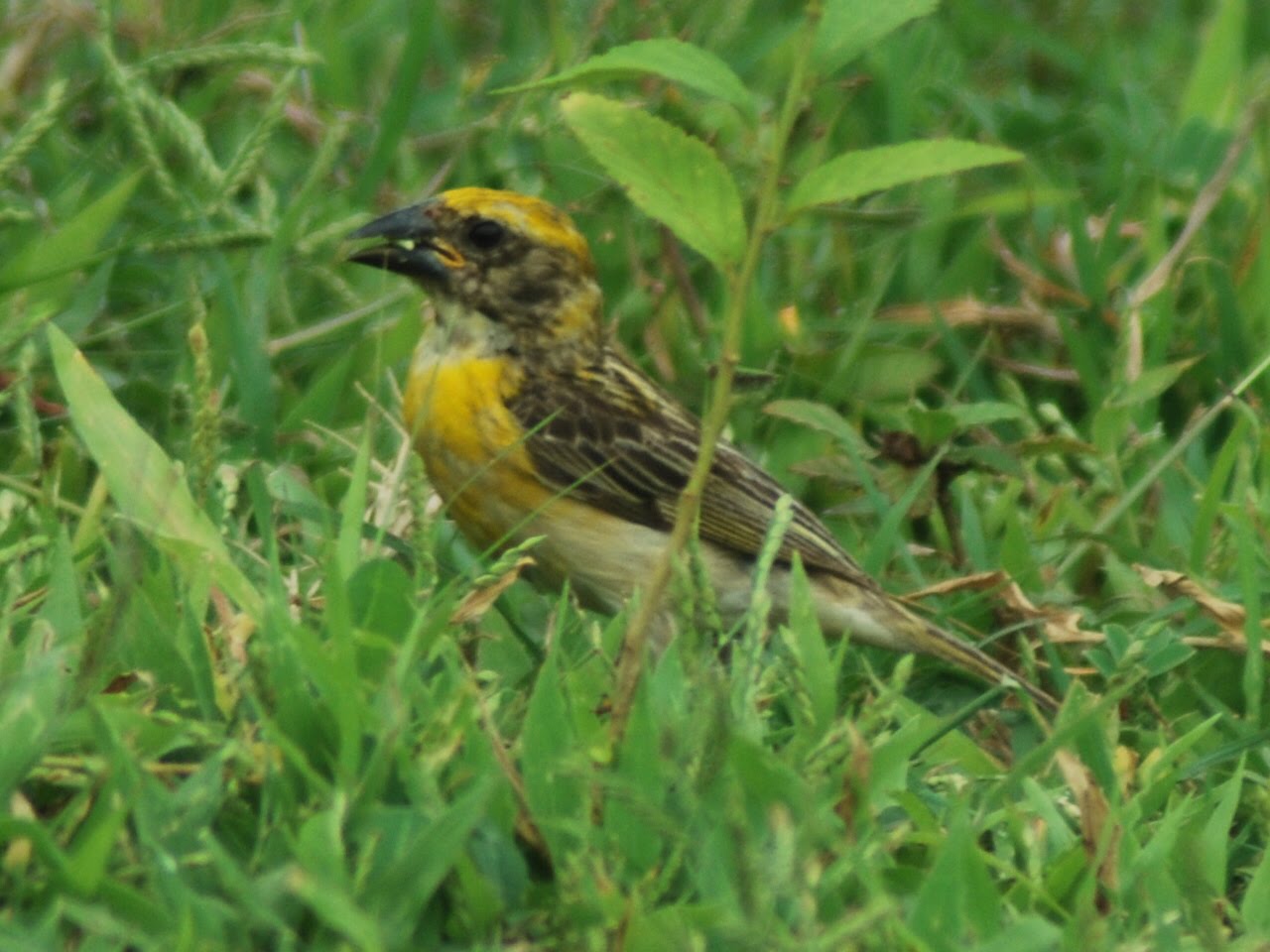
Baya weaver: the master craftsman


As the name suggests these birds are known for their exquisite nests (like Tailorbird- incidentally I spotted one at turf club shrubs…I am seeing tailorbird after a longtime last spotting probably was at Sultanpur about seven years back!), that are woven out of grass, the long mouth pointing down, they hang from outer bough of trees. To enter these the bird has to shoot up in full flight (tricky that one), making it predator proof. About a decade back I got an abandoned baya nest from bharatpur (we treaded the swamp and had to do some work to pluck it from the tree) that adorn my room for many months. I had plans of lighting it with green lights and so on, during shifting the nest unfortunately got crushed. When you observe these nests minutely you know how intricate piece of work it is, and yes birds don’t have hands that makes it a miracle!. Baya nests are quite common in countryside, so next time you come across one don’t fail to stop and appreciate these little birds.
Baya males acquire a distinctive yellow plume and striking black mask during breeding season. They are found in abundance in open arable field that has few trees, damp areas are preferred. Can cause harm to crops (what is that compared to rotting in godown!!) but does compensate by feeding on caterpillar, grasshopper so on.

Mahadevi Verma

What is pity looking for
in the mirror of raindrops?
What are waves searching
in the throbs of the sea

Mahadevi Verma (1902-1987) was major Indian Hindi poet, married at early age she rebelled against child marriage and pursued higher studies, later was active in freedom struggle. She was awarded the highest literary award in the country: the Jnanapeedam (or Jnanpith, as north Indian put it) in 1982. Mahadevi Verma belonged to the Chhayavad school of Hindi poetry, other important poets of this school included Jayashankar Prasad, Suryakant Tripathi “Nirala” and Sumithrananadan Pant…all these poets we have studied in school. Chhayavad was more in line with Romantic school of the west, the emphasis was on nature, ‘Chhaya’ being shade-implying nature as comforter and partaker of joy and sorrow, an unfailing companion. The poems exemplified fineness of sentiments and lyricism (of course lost in English translation), these lines from her poem “Ever vigilant eyes”

Has storm slept with soft breeze as pillow?
Has the curse of the world come as everlasting sleep?
Why does the child of immortality want to embrace death?
Wake up, you have far to go.

Chhayavad had strong current of humanism that is universal, unrestricted and all embracing. Mahadevi Verma had immense understanding of Vedic and other ancient philosophies. One can observe traces of Vedic tradition in her poems-seeing formless in tangible, abstract in concrete. There is a strong element of bhakti school too, the overwhelming presence of divine love and longing (it needs Indian mind to understand, for most in West life began and end with Freud !!. Pity)
Lord, the distance between us is full of joy,
the moment I came in contact with you
all my dream-world will be shattered,
but even so I do not wish
to be away from you

These from another poem

When the sea tremble like a pearl
in the golden shell formed by the earth and the sky,
and the cloud float like soft cluster of snow
in the brightness of silver sea,
the like fragrance one who gently caresses me-
who is he like a breath emitted during my slumber?

These lines from the poem “Gathering like clouds”

When could the fiery rays of the sun
take away compassion from my heart,
when could the beautiful stars in the sky
deviate me from my path?
The pride of majestic sky I brought
upon the earth and it brightened the world.

These lines from “If you do not grapple”

If you do not grapple with
the rising waves of the sea,
which tide will take you
across on the other side?
….
The eyes of idol god shine bright with the light of the lamp,
and its rays come as a blessing to the temple priest,
will not the fiery laughter erase the traces
of destruction carved on the hard rocks?

Wednesday, August 15, 2012

The plaintive calls of Paddyfield Pipit

  Pipits are quite difficult to classify, and becomes much complicated during migratory season. It needs lots of scrutiny and experience to correctly classify a Pipit. They are found throughout India and as the name suggests Paddyfield Pipits are seen in plains, grasslands and fields with low crop cultivations. They fly with a weak plaintive call when disturbed before settling, rarely arboreal. When disturbed from nest the female flutters along the ground as if wounded, a habit that is common to most Pipits.

Frank Collymore: the Caribbean spring

I was searching for someone I could write about and came across Frank Collymore (1893–1980), an amazing man. He was well-known author, poet, acclaimed Barbadian man of letters, stage performer and painter, but importantly played a significant role in launching the careers of Derek Walcott, Kamau Brathwaite, George Lamming, Austin Clarke, and Edgar Mittelholzer (to name a few) through Bim and "Caribbean Voices". His influence has even shaped modern Caribbean letters. To know that he never went to university was quite a revelation. Collymore was school teacher and retired as deputy headmaster, he spent sixty years at the same school! His influence on generations of boys was profound, and played an important part in making Combermere one of the leading schools in Barbados, a position it continues to enjoy to this day.

Collymore’s influence was far-reaching in a number of ways. He published several volumes of poetry and a number of short stories, most of which were posthumously collected in The Man Who Loved Attending Funerals (1993). As a lover of literature, he was also a dedicated and selfless encourager of the work of others, lending books to aspiring writers from their schooldays onwards, publishing their early work in Bim, the literary magazine he edited for more than fifty issues from the 1940s to the 1970s.

I did search for his poems in the Net but surprisingly couldn't find much except this one…

Days End

Sometimes when the day is ended
And the duties of day are done
I'll watch at the western window.
The glow of the setting sun


When the day is vexed with trials
And I cannot see my way through
Then I think of that "Beautiful City"
That lieth not far from view


Then I think of the beauties of Heaven
What splendor I there shall behold
When I reach the portals of heaven
And view the City of Gold


There will fall on my restless spirit
A calm, oh so wonderful sweet
And I shall cross over the river
To rest at my Savior's feet.

from my scribble pad... 
Aftermath of violence

Someone will rummage through the charred belongings
Someone will search for her missing toy
Someone is holding on to the tenuous thread of sanity  
Someone will henceforth live in memories
Someone will not trust
Someone lost the reason to speak
Someone will not dream

Fighting gods
(an autorickshaw driver at Thrissur)

Pendants hung from the rear mirror
one had Hunuman in flight with miniature mountain on a hand,
the other a Cross, another a minaret.
It had got entangled, i pointed this to him.
‘Yes these gods have problem. They fight with each other!!’ 


Friday, July 20, 2012

Long tailed Shrike: the butcher bird


  All Shrikes have black bands over their eyes, and they look great the little bandits!! Long tailed Shrike that i get to see very often avoids dry as well as thick forests, preferring edge of the forests or open areas of cultivation where they perch on vantage position so that it is able to survey for insects or small reptiles. With sharp intent eyes it waits for movement in the bush, and then swoops. The hooked bill is meant to tear into the flesh of victims; it’s a ferocious bird and means business. Shrikes are referred to as ‘butcher bird’ for the reason that it doesn’t stop hunting even if its appetite is satisfied and so stacks surplus victims onto a thorn. It does have a lighter side and doesn’t shy away from miming its garrulous neighbours. 
      
The paaddanas of Tulus

Tulu language is one of the earliest offshoots of Dravidian language, quite a sophisticated language it didn’t really develop classical literature but there is treasure of folk literature that is handed through folk traditions. Considering the limited area in which this language is spoken, the folk ballads can be ranked quite high in folk literature tradition of the country. It’s amazingly vibrant and marvellous in its melody and rhythm. Not only do the paaddanas maintain high aesthetic sensibilities but are a study on socio-cultural history as also the nature –animals, trees, snakes, birds...  The word paaddana comes from Dravidian root paadu i.e. ‘to sing’ and the traditional singers are referred to as pambada or nalke. The paaddanas can be religious or ritualistic as also secular with entertainment value. It is speculated that origin of highly stylised dance forms like Yakshagana traces its roots in Tulu folklore traditions.  One thing that stands out in the tulu folk literature is that they are free from influence of other cultures and oral traditions. It is believed that the supreme god sends the spirits (bhuta) to Tulunad to uphold laws and righteousness, and these spirits descend from forests. The paaddanas provide framework for traditions and values of tuluva life. These lines from Panjurli Paaddana describes not only the splendour of tulu land but is a study on sheer beauty of language use...

Tirtu tuluva raajya tuunaga baari porlu toojindu
Satiigedaatu malle , arivaannadaatu urutu, panavudaatu porlu
Tirta tuluva raajya yaanu oppuve

Tulu kingdom below looks exceedingly pretty
Specious like umbrella, round like the worship platter,
Pretty like the coin, i approve of tulu kingdom below

The above may look like simple lines in the translation; apart from rhythm what is sought is the roundness that connects the worship platter, umbrella, coin...so on.

   Tulu speaking people inhabits the coastal region extending from Kasargod in Kerala to Udupi and Uttara Kannada in Karnataka -a protected terrain bound by the ghats in the East, the sea in the West and rivers in North and South. Tulu is classified as ‘Vulnerable’ language (in the list of endangered languages).  The term Tulu seems to have originated from word water (note in Malayalam/Tamil ‘tulli’ means drop). Tuluvas are quite an enterprising set of people. Till recently i was under the impression that Tulu doesn’t really have a script and used Kannada, then i happen to visit Tulu Sahitya Academy at Mangalore. So they do have a script! I am rather surprised since it is almost Malayalam, indeed i could read seventy percent of it!!

One of the popular paaddana deals with the story of Koti-Chennaya, with another one ‘Siri’, is a major epic in tulu folklore. Koti-Chennaya deals with twin brothers as cultural heroes. The story was translated into English as early as in 1886 by one Mr. Manner, another two followed in 1894 and 1895. There are now lots of translations available, even the first Tulu film ever to be made was on this story. Few translated lines from the original ballad...

murampayi uddala mallige
kebit kenjava nirmuder...ye
tigaled ambrata gindevundu ...banjid
basing devereg....ye
berit bhimana arjunere
kondudu nirmuder...ye
morampudu mulla onji kaveri
indra parvata bermereg...ye
okkod olimulla...rayervundu padodu
panipanca naramugala...ye

The translation...
 
He wears the knee length jasmine flower
from his ears, kenjava birds, he creates.
On his chest, a small goblet of nectar, around his stomach,
gem studded ornament –god has.
On his back, of Bhima’s and Arjuna’s
Combined strength he creates.
A river that flows from his knees,
And the Indra mountain, Bermer possesses.
A serpent like girdle encircles his waist, and his feet glitter,
With the panipanca ornaments, worn on his toes.

nal kodidavu deyya deverle japa
karpodnd panderge...ye
muji kanna tarayi nirmuder
orkanna bajjeyi nirmiyer...ye
orla bolenteda ari nirmiyer vilya
pingara nirmuder...ye
kekkil uddada jaladigu
dever avulu jader...ye
jaladi nadutu radd boliya attasada
mundala kodi iren...ye
dever avulu nirmidere
irepadd aripadd...ye
suttige diyer nalu kodida deyya
deverle janider...ye

The translation...
‘For the spirits and the gods of the four directions, chanting of holy names
Must be organised’ says God Surya Narayana.
He creates –coconuts with three eyes
And areca nuts with one eye.
He produces –one seru of white rice, betel leaves,
And the areca flowers.
Into the neck deep stream,
God gets down.
In the middle of the stream, of the white holy fig tree, two
Short, front section leaves,
God creates.
Placing the leaves and putting rice on the leaves,
God keeps suttige. Of the four directions –the gods
And the spirits –he brings them to life.  

From my scribbling pad...

Soothing sleep
O benign divine, give the hymns
that balm the still night in silent slumber
cast the spell of fairy order in the disintegrating allure.
In the shadow of soul where disquiet dwell
lull the willing eyes into soothest  of sleep


Tuesday, June 5, 2012

cycling in the monsoon...


“Ecstasy is inland soul going to the beach” is what Emily Dickenson said, this blogger would add “ecstasy is cycling along the beach in the monsoons!!”…O the feel of rain drenching the body, and soul. . It’s heaven. Nothing can top it. It is one of the precious experiences in life. 

 I would like to thank Els here for wonderful inspiration on cycling. She and her gang cycle across Europe regularly. She was kind enough to mail me valuable inputs on cycling.  You may visit her at http://bikesandbees.blogspot.in/. Thanks to her I am going pro!!!

(visit me at www.depalan.blogspot.com for more) 

Thursday, May 24, 2012

Darter: The hug me bird


Darters are large sized slender bird that can be found sitting next to water body with its wing spread as if to hug someone. In reality these birds like their closer cousins cormorants don’t produce oil that water proof their feathers and so has to dry their wings constantly, so much so darters found in America migrate to get bright sun. The reason for lack of waterproof feathers is that like most birds they are light and have to increase their weight, waterlogged feathers allows it to dive easily and helps faster underwater movement. However, once they emerge from the water, they need to dry themselves. They also squeeze their feathers through their bill to remove excess water and repel water with oil from their enlarged preen gland at the base of the tail. It has great difficulty getting off the water if it attempts to fly while its wings are wet and takes off by flapping vigorously. Darters are widespread without being common. They inhabit either fresh or brackish water and can be found in lakes, rivers, marshes, swamps, estuaries, bays, lagoons and mangrove swamps. It prefers tree trunks, branches, stumps or posts fringing the water, for resting and drying its wings.Darters got their name as they use long (about twice the length of the head) sharply pointed bill to spear or thrust prey when they dive, the fish is pierced from underneath, brought to the surface where it is flicked into the air and then swallowed head first. Smaller items are eaten underwater and large items carried to a convenient perch and then swallowed. Darters are also known to spread their wings and tail underwater to lure fish into the shade underneath, before spearing them. They are also referred to as snake bird as they have snakelike head and a very long curved neck, and often swims with only the neck above water, with side to side movement like a snake ready to strike. They have short webbed feet making them excellent swimmers, submerging without even a ripple (10 on 10 effort in Olympics!!) their eyes are set in the beaks for efficient underwater hunting. While its gait is clumsy on land, it can soar gracefully to great heights on thermals, soaring on motionless wings, it makes cross-shaped silhouette when flying giving an impression of a glider.
These birds belong to the family Anhingidae. In south Asia the commonly found darter is refered to as Oriental Darter (Anhinga melanogaster). There are four living species. The word "anhinga" comes from the Brazilian Tupi language and means devil bird or snake bird. The stamp posted herein is from Liberia (President of liberia Ellen Johnson-Sirleaf is Africa's first elected female head of state), the painting of darter is from Audubon collection.

I came across these lines by Nobel Laureate Richard P. Feynman (1918-1988)

"You can know the name of a bird in all the languages of the world,
but when you're finished,
you'll know absolutely nothing whatever about the bird...
So let's look at the bird and see what it's doing - that's what counts.
I learned very early the difference between knowing the name of something and knowing something."


How precise!!. Feynman was an American theoretical physicist who was widely regarded as the most brilliant, influential, and iconoclastic figure in his field in the post-World War II era. He was one of the celebrated and revered scientists of modern times, he was multifaceted and had interest in many fields. Feynman remade quantum electrodynamics—the theory of the interaction between light and matter. The problem-solving tools that he invented—including pictorial representations of particle interactions known as Feynman diagrams—permeated many areas of theoretical Physics in the second half of the 20th century. Feynman invented a theory of “partons,” or hypothetical hard particles inside the nucleus of the atom, that helped lead to the modern understanding of quarks.

In his memoir Feynman mentions the reason for being in the Manhattan project. He says he felt the possibility of Nazi Germany developing the bomb before the Allies was a compelling reason to help with its development for the U.S. However, he goes on to say that it was an error on his part not to reconsider the situation when Germany was defeated. Feynman also talks about his worries in the atomic bomb age, feeling for some considerable time that there was a high risk that the bomb would be used again soon so that it was pointless to build for the future. Later he describes this period as a 'depression'. (all inputs taken from Net).


White browed fantail flycatcher: the restless dancer


No other bird will surpass its liveliness and elegance. This is one bird that doesn’t sit still it pirouettes about the shady branches of trees incessantly fanning its tail like a dancer who is restless to dance and doesn’t mind if there is an audience or not. The moment it settles down after a sortie to catch flying insects –that in itself is a delight to watch- its  body jerks as if it cannot go without another round of dance and takes one dainty step here one step there, drops its wing, up the head, and spread and close the delicate round fan shaped tail. You will be mesmerized by the bird for few more minutes and then off it goes. Fantails don't have any qualm about human presence, indeed is quite bold. So any readers of this blog happen to spot a fantail be an audience you will cherish for a long time. And yes it is a good singer too and is also known for beautiful nest it makes.

Wislawa Szymborska: Isn’t sunset a little too much for two eyes!!

It was I think in the year she got the Nobel that I came across the name Wislawa Szymborska, and really loved the way it sounded …of course people found it amazing that I could recall these complicated names!! (they should have known that remembering names is what I am really not good at…I go by how it sounds and I can recall hundreds of sounds which in turn are names!!). So here I was enjoying the sound of the name and very soon I had started to read her poems. She probably is the most exciting contemporary poet in the world, I am also very much influenced by her thoughts (encapsulated in her Nobel Prize speech that I have read many times). Wislawa Szymborska was born in Poland (1923) she worked as translator for sometime. Her poems have charming understated irony. “Excess of kindness could kill us” is how she describes the wonders of nature “Isn’t sunset a little too much for two eyes”. O yes!!. How much I love these lines.

While trying to plumb what the void's inner sense is,
I'm bound to pass by all these poppies and pansies.
What a loss when you think how much effort was spent
perfecting this petal, this pistil, this scent
for the one-time appearance, which is all they're allowed,
so aloofly precise and so fragilely proud

These lines from ‘Silence of Plants”. It is a kind of poem when you read you admire so much that can be in danger of being possessive “now now that is something I should have written!!”

But how does someone answer questions
which have never been posed,
and when, on top of that
the one who would answer
is such an utter nobody to you?

Undergrowth, shrubbery,
meadows, and rushes…
everything I say to you is a monologue,
and it is not you who's listening.

A conversation with you is necessary
and impossible,
urgent in a hurried life
and postponed for never.

The war zones we have seen so many tines in TV, people stranded…

They abandon something close to all they've got,
sown fields, some chickens, dogs,
mirrors in which fire now preens.

Their shoulders bear pitchers and bundles.
The emptier they get, the heavier they grow.

What happens quietly: someone's dropping from exhaustion.
What happens loudly: someone's bread is ripped away,
Someone tries to shake a limp child back to life.

Few more line from the same poem (it is not right to dissect poems like this but then it will make the blog too long)

Some invisibility would come in handy,
some grayish stoniness,
or, better yet, some nonexistence
for a shorter or a longer while.

Something else will happen, only where and what,
Someone will come at them, only when and who,
in how many shapes, with what intentions.
If he has a choice,
maybe he won't be the enemy
and will let them live some sort of life.

These lines from “One version of Events”.

We were besieged by doubts.
Does knowing everything beforehand
really mean knowing everything.

Is a decision made in advance
really any kind of choice.
Wouldn’t we be better off
dropping the subject
and making our minds up
once we get there.

We looked at earth.
Some daredevils were already living there.

A feeble weed
clung to a rock,
trusting blindly

that the wind wouldn’t tear it off.

A small animal
dug itself from its burrow
with an energy and hope
that puzzled us.

We struck ourselves as prudent,
petty, and ridiculous.

In any case, our ranks began to dwindle.
The most impatient of us disappeared.
They’d left for the first trial by fire,
This much was clear,
especially by the glare of the real fire
they’d just begun to light
on the steep bank of an actual river.

A few of them
actually turned back.
But not in our direction.
And with something they seemed to have won in their hands.

This my favorite “The little on the Soul”. I have read this many times, it is an assertion that is part of all of us. It is so much fun this one…

Periodically one has a soul.
Nobody has it all the time and forever.
Day after day, year after year
can pass without it.

Sometimes only in rapture
and in fears of childhood
it dwells within longer.
Sometimes only in the astonishment,
that we have become old.


It rarely assists us
in strenuous pursuits,
such as moving furniture,
carrying suitcases
or tromping through a road in tight shoes.

While filling in forms
and chopping meat
it usually takes the day off.

In a thousand of our conversations
it participates in one,
and not even necessarily in one,
preferring silence.

When our bodies start aching more and more,
it silently leaves the ward.
It's fussy:
it doesn't see us immediately in a crowd,
it sickens at our attempts at mere advantage
and the shrill clamor of business.

Joy and sorrow
are not all that different to it.
Only in the combination of them
does it stand up.

We can rely on it,
when we are certain of nothing,
and when everything seizes us.

Among all material objects
it likes best clocks with pendulums
and mirrors, which work fervently,
Even when nobody looks.

It doesn't say where it comes from
and when it will disappear next,
But it clearly awaits such questions.

It looks like,
as much as we need it,
also it
needs us for something too.


Waking up to the call of Malabar Whistling Thrush


There is a whistle that echoes through the morning mist of Western Ghats. Wafting the ravine forest and churning mountains it resonates in unmistakable gaiety. The resplendent rising sun is hummed to a bright new day. It’s the Malabar Whistling Thrush adding its oral aesthetes to the verdant visual. Whistling schoolboy is an alias that adds to its nonchalant splendor, the boyhood of yore. The lines from James Whitcomb Riley’s poem ‘To a Boy Whistling’ was never so apt    
          
O happy boy with untaught grace!
    What is there in the world to give
    That can buy one hour of the life you live
Or the trivial cause of your smiling face!

Malabar Whistling Thrush aka Myophonus horsfieldii are endemic to Western Ghats. It carries its shiny patches of blue on the forehead and shoulders with aplomb.    

James Whitcomb Riley: We are not always glad when we smile!!

James Whitcomb Riley (October 7, 1849 – July 22, 1916) was an American poet and writer, who after a squalor origin gained immense popularity in US that he elevated to the status of national poet. The book titled the Rhymes of Childhood was his most popular work. I am putting some of his poems here that I found interesting, of course many more can be read in the Net.  

Plain sermons

I saw a man—and envied him beside—
    Because of this world's goods he had great store;
But even as I envied him, he died,
    And left me envious of him no more.

I saw another man—and envied still—
    Because he was content with frugal lot;
But as I envied him, the rich man's will
    Bequeathed him all, and envy I forgot.
Yet still another man I saw, and he
    I envied for a calm and tranquil mind
That nothing fretted in the least degree—
    Until, alas! I found that he was blind.
What vanity is envy! for I find
    I have been rich in dross of thought, and poor
In that I was a fool, and lastly blind
    For never having seen myself before!

If I knew what poets know

If I knew what poets know,
    Would I write a rhyme
Of the buds that never blow
    In the summer-time?
Would I sing of golden seeds
Springing up in ironweeds?
And of rain-drops turned to snow,
If I knew what poets know?
Did I know what poets do,
    Would I sing a song
Sadder than the pigeon's coo
    When the days are long?
Where I found a heart in pain,
I would make it glad again;
And the false should be the true,
Did I know what poets do.
If I knew what poets know,
    I would find a theme
Sweeter than the placid flow
    Of the fairest dream:
I would sing of love that lives
On the errors it forgives;
And the world would better grow
If I knew what poets know.

Song of the New Year

I heard the bells at midnight
    Ring in the dawning year;
And above the clanging chorus
    Of the song, I seemed to hear
A choir of mystic voices
    Flinging echoes, ringing clear,
From a band of angels winging
    Through the haunted atmosphere:
        "Ring out the shame and sorrow,
            And the misery and sin,
        That the dawning of the morrow
            May in peace be ushered in."
And I thought of all the trials
    The departed years had cost,
And the blooming hopes and pleasures
    That are withered now and lost;
And with joy I drank the music
    Stealing o'er the feeling there
As the spirit song came pealing
    On the silence everywhere:
        "Ring out the shame and sorrow,
            And the misery and sin,
        That the dawning of the morrow
            May in peace be ushered in."
And I listened as a lover
    To an utterance that flows
In syllables like dewdrops
    From the red lips of a rose,
Till the anthem, fainter growing,
    Climbing higher, chiming on
Up the rounds of happy rhyming,
    Slowly vanished in the dawn:
        "Ring out the shame and sorrow,
            And the misery and sin,
        That the dawning of the morrow
            May in peace be ushered in."
Then I raised my eyes to Heaven,
    And with trembling lips I pled
For a blessing for the living
    And a pardon for the dead;
And like a ghost of music
    Slowly whispered—lowly sung—
Came the echo pure and holy
    In the happy angel tongue:
        "Ring out the shame and sorrow,
            And the misery and sin,
        And the dawn of every morrow
            Will in peace be ushered in."

To Annie

When the lids of dusk are falling
    O'er the dreamy eyes of day,
And the whippoorwills are calling,
    And the lesson laid away,—
May Mem'ry soft and tender
    As the prelude of the night,
Bend over you and render
    As tranquil a delight.

We are not always glad when we smile

We are not always glad when we smile:
    Though we wear a fair face and are gay,
        And the world we deceive
        May not ever believe
    We could laugh in a happier way.—
Yet, down in the deeps of the soul,
    Oft times, with our faces aglow,
        There's an ache and a moan
        That we know of alone,
    And as only the hopeless may know.
We are not always glad when we smile,—
    For the heart, in a tempest of pain,
        May live in the guise
        Of a smile in the eyes
    As a rainbow may live in the rain;
And the stormiest night of our woe
    May hang out a radiant star
        Whose light in the sky
        Of despair is a lie
    As black as the thunder-clouds are.
We are not always glad when we smile!—
    But the conscience is quick to record,
        All the sorrow and sin
        We are hiding within
    Is plain in the sight of the Lord:
And ever, O ever, till pride
    And evasion shall cease to defile
        The sacred recess
        Of the soul, we confess
    We are not always glad when we smile.

From my scribble pad… 

Sun after the rain
It’s like a faint touch of soul departed
revealed in a prospect.
An apparition hanging within the indolent cloud
the glint on each leaf magnifying the vividness of it.
All my life capsulated in this instance
in this lone moment
when death matters the least