Tuesday, March 4, 2014

Pretty bird is Crested Bunting


 The Crested Bunting (Melophus lathami) is a bird that could easily get into the prettiest Indian birds list. Though I saw this one on a walk at the foothills of Himalayas last summer as a migrant, they are resident of central Indian hills. 
  

Keshavasut: the pioneer of new age Marathi poetry


I am the new soldier
with new spirit
of the new age.

Insatiable my hunger,
no crumbs will do.
I am not a frog in the well,
my land shall be without a fence,
who dares bind me!


I was at Ratnagiri, a coastal district in Maharashtra, about two hours in the bus is a small village Malgund that is the birthplace of Krishnaji Keshav Damle alias Keshavsut. The house has been converted into a memorial. There is also, a spartan but quite tastefully done, museum of major Marathi poets and also guest houses for resident researchers.


Keshavsut (1866-1905, barely 39 when he died) is one of the foremost Marathi poets as also a significant presence in Indian literature. He made a complete departure from traditional Marathi poetry styles –that was stuck in time warp, and brought in new breeze of freshness, he revolutionized Marathi poetry both in its form and content. Keshavsut is now hailed a harbinger of new age of Marathi poetry. The word ‘now’ is key here because during his lifetime he didn’t receive any recognition and shockingly was treated with derision. He loudly protested against tradition bound poetry and cruel inhuman social traditions and customs. Apart from this he is the first Marathi poet to write about different aspects of nature. He largely lived a life of anonymity and only produced a slender volume of 132 poems which were published, as a collection, posthumously. 


 “Keshavsut achieved for Marathi poetry what Hari Narayan Apte did for Marathi novel –endowed with a truly creative power” (Kusumavathi D in History of Marathi literature).  He used everyday words used by common people, which were considered unpoetic and harsh by the orthodox. He gave new energy and confidence to the common place with his ‘unusual sincerity of expression’.  His poems were close to nature and Wordsworthian in its simplicity and subtlety. Being part of society and quite aware of discriminations (unlike many so called great Indian literary figures) that existed in the society he raised his voice, many of his poems reflects this concerns. He called for ‘urgent social reform’. He was a ‘vigilant humanist who wanted to fight all sham conventions and rusted customs. He was against any differentiation between people…” 

I do not envy their luck,
A dry and coarse bread is enough for me,
I am ready to die, O god! In hard work,
why do you kill me with starvation?

Lord! If all are equal in your eye,
why are you callous to the poor?
To some you give delicious food,
why don’t you give me one simple bread?

(from the poem A Worker forced to starve)


 Despite the fact he was in the midst of early awakening of demand for freedom from colonial power after 1857 independence struggle, the nascent nationalism was soon a wildfire among the poets and thinkers of the time, Keshavasut was able to correctly see through the revivalist self-deception in the nationalistic fervour and chauvinism that comes with it. It is rather remarkable since these were 1880s Pune, a region that would see much of obscurantism in years to come. He very assiduously avoided the temptation of being nationalist poet and gain popularity.     


All these poems are translated from Marathi (by Prabhakar Machwe), so may sound jarring sometimes, the original I am told is quite nuanced. Whatever may be the case even in English his intent and compassion comes out quite distinctly; that he was sensitive to his surroundings is very clear. He didn’t live in isolation in the name of art, that is nothing short of criminal in the context we live, but was vigorously involved and responded to the realities of surroundings. A century back the social reality was much crude and brutal. You will see such arrogance in RK Narayan’s works specifically in his thoughts (as essays) –he created world devoid of any blemishes, if any, was seen as adorable excesses. Nothing wrong but then to live a life absolutely unconcerned to these realities is shocking. Keshavsut lived not much before likes of Narayans. These poems were written in 1880s…


The First Question of the Untouchable child

The children of untouchables,
poor, gay, playing on the roadside –

A Brahmin came from far
to the simple kids what he say
‘O you brats of Mahars, move away,
be gone! What are you playing, you louts?
Run away give way to the Brahmin!’

The children fled –who would dare stay!
One amongst them did;
The wicked Brahmin brandished his club and shouted,
‘Ass! your shadow may not fall on me,
get gone or else this ‘sweet present’!’

the kid too slunk homewards,
musing –
‘What if my shadow fell on him,
what’s so wrong about it?’
At home he asked the question to his mother,
The poor mother said:
‘We are low and they are high,
When you see them, you had better step aside’
She said so –simply.

How would she know
that highness in this world is built
on sin and glory
on the degradation of others!

Iconoclast

Break the icons, hurry,
hurry, break the idols!
and grab all wealth inside.
Of what use are offerings,

why rub your nose on the ground
We are from the hills, rough and uncivil,
we want only wealth!
The sorceress crouches with a riddle –
fail to solve it and she will devour you.
We don’t want to fall into her trap,
so let us beware.

We shall break open the idols
and then reassemble the bits.

But we shall not sell them –
those who sell the gods are bastards
they are the real thieves, not we!

I rather liked this one the “Glum Faced”, what is shocking for me is that I wasn’t aware of Keshavsut so far!! That not only is a statement on our education system but also the contemporary society that thrives on mediocrity and celebrates inane that the best of Indians don’t even get a passing reference.

Glum-Faced
(in the classroom a teacher called me ‘glum faced’ and I thought…)

O Guru, my face is glum.
Yes, all who look at it are disappointed.
All know it, it is so obvious.
But why did you have to say it?

What pleasure did you get thereby?
“His face is glum, indeed, but who knows
providence might make him sing
new poems to make the world and people happy!”
Did such a simple thought, for a moment,
cross your sophisticated mind, goodness gracious!

The people whom you think are ants,
O Guru! they might fly like birds in the sky,
those who seem ash heaps may have hidden embers,
to burn the whole world to ashes, who can guarantee?
From this very glum face of mine may flow in days to come
a stream, beautiful, ever-present –
if not you, your children might quench their thirst drinking it.
Nobody then would ever ask, ‘How was the poet’s face?’


It’s the Tabebuia bloom happening!!


There is one tree that has decided to show off and has even shed all its leaves for its bright yellow trumpet flowers. O it’s a yellow riot going on here!! Tabebuia aurea is in all its glory and this will last throughout the March is an ecstatic reality.  And this tree is not even native of India, they are from dry forests Brazil. Take your time to have a good look at this one.


From my scribble pad…


What the silly dog doesn’t know

Again there was a flare up on the street where two alleys meet.
A fellow beat up another who returns the favour with much interest.
A crowd had gathered to watch. 
Behind the garbage bin the mongrel too witness the drama in amazement.
He asked me what the fuss was we too fight but never this bother.
Ah that is where we differ from you mindless mongrel.
The human muck burst intermittently but a persistent impulse.
Ambivalence no longer the shield
to bear the spectacle of depravity
A primal thread binds the souls as nothing else can.
So this audience.
The gasp.
They call it sports.
Sometimes it is a war.       


Saturday, February 22, 2014

Ashy crowned Sparrow lark: The camouflage specialist


I was at Haveri, about 25Km is Bankapur fort, from here about 10km (there is a tempo that is quite infrequent) is Baada, you will have to walk about a km to reach Kanakadasa’s birth place. There seem to be elaborate plans to develop the place; you could see some construction activity.  While I was walking on this shrubby terrain strewn with rocks that a bird fluttered and bolted away few feet from me, he so very well camouflaged that I didn’t see. So I walked cautiously to witness Ashy crowned Sparrow lark male in its full glory, it has quite a peculiar way of descend. You could see from the picture above how beautifully he blends into the surroundings. 


Ashy crowned Sparrow lark (Eremopterix griseus) is a sparrow sized bird of lark family that can be seen throughout the peninsula in the shrubby habitat. They nest on the ground, in small depressions.   


Kanakadasa, a saint poet and reformer 


Kanakadasa was 16th century philosopher saint and poet, originally Thimappa Nayaka, he was a warrior (and did not belong to “warrior community” as many writings seem to point out. This is temple squatter’s deviant way of looking at things that has become dominant narration, since there is no ‘community’ that can claim to be warrior or non warrior, these are not decided by society but by individual choice and competence. The reason for Indian society’s incompetence could be traced to these frameworks of assigned occupation which even our Gandhi found some charm!! These ideas still thrive in mediocre India, quite ironically Kanakadasa was fighting against these very evils), he got injured in one of the battles, during this period he had some sort of enlightenment. He is in many ways comparable to Kabir, in using common people’s language and motif to express nuanced insightful thoughts. It is a statement on his talent and compassion for the plight of common people that even after 500 years he remains immensely popular in Karnataka region. He is so popular that many of his writings are part of well received Karnatic songs. Movie on him in Kannada (none other than Rajkumar played the role of Kanakadasa, has become a classic). Incidentally Kanakadasa’s birth anniversary, Nov 20, is a state holiday in Karnataka. Though i must point out here that the English translation of his work is very hard to find (I checked out each and every bookstall and library in Mysore).     


Kanakadasa belonged to the tradition of Haridasa literary movement, who wrote devotional compositions which could be set to music with simple instruments. This movement was part of Bhakti movement that held its sway from 14th to 19th century. His concerns were directed against casteism and the devilishness it spread. In one kirtana he tells how people neglect their duties but call themselves “pure”. He says that "bathing in the river without conquering internal pride, envy and wrath is meaningless" and "exhibiting hyperbolic devotion is like an actress exhibiting her illusory beauty." He was stridently against rituals. Commenting on the hypocrisy, he says that he would like to be a servant of a chandala than to be a vicious ‘Brahmin’. His songs were dedicated to the lord and sought to connect to common people, he even used the allegory of humble food of the poor, ragi, to bring out the truth. 


The story goes that he once visited the famous (infamous is better suited) Krishna temple in Udupi but the temple squatters did not allow him in.  His devotion was such that, it is said, the lord i.e. the statue bent and turned west and gave him darshan through the window. Even today devotees visiting the temple try to relive the joy by peeping through this window. It seems like a good story but I have strong objection to the morals here. The zombies (read devotees) who accept these nonsenses should question the temple squatters on their propriety. It is a deeply disgusting matter that progenies who denied Kanakadasa are most likely running the temple. The soul of Hinduism is so very dark. Instead of questioning discrimination met to Kanakadasa, it is being celebrated with miracle story. Quite clearly these miracle stories were little squatter’s daily trick, Kanakadasa being an enlightened man was sought to be included through miracle, anything less than miracle will not be in the scheme of things, further it added to the branding of the temple. I stayed in Malpe beach for three months many years back and never went to this temple, frankly I don’t go to temples, it makes me sick. I find presence of temple squatters deeply disturbing unless they are evicted Hinduism remains a cesspool of muck, the reason the edifice (i.e. the society) is so very deviant. People having temple squatter surname are similar to nazi symbol on the forehead, probably it is much worst. Since Indian elitizens will not allow breach and common people are religiously driven zombies (I don’t blame them they work under overwhelming odds), it is for the international community to take action. They must deal with these very strictly and take the Indians to task for this heinous system that has been so far sold as some kind of cultural diversity, the crass impunity is shocking. There is a severe human right violation happening here. It is much worse than racism. Indians with genocidal surname should be denied visa by the international community!! 
   

English Translation of Nee Mayeyolago
 
Are you a creature of illusion? or illusion your creation?
Are you a part of the body? Or is the body a part of you?

Is space within the house? Or the house within space?
Or are both space and the house within the seeing eye?
Is the eye within the mind? Or the mind within the eye?
Or are both the eye and the mind within you?

Does sweetness lie in sugar, or sugar in sweetness?
Or do both sweetness and sugar lie in the tongue?

Is the tongue within the mind? Or the mind within the tongue?
Or are both the tongue and the mind within you?

Does fragrance lie in the flower? Or the flower in fragrance?
Or do both the flower and fragrance lie in the nostrils?
I cannot say, O Lord Adikeshava of Kaginele,
O! peerless one, are all things within you alone?

From my scribble pad…

Thoughts to be pulped

Gandhi, I read
was a mahatma
apostle of peace and bearer of non-violence.
He stands like a statue on busy street
clutching his lathi in a rigor mortis thought.
Alright let’s give him a break
Here he comes down from his high pedestal
And swing his lathi at the sleeping policeman
Take the cheating politician by his throat
and chase the goon down the street
Gives the children lesson on morals
and teachers some guidance.
Feed the poor from his pocket.
Meets the business leaders and extol them to contribute for society
Calls on the scientific community to be inspiration
Speaks on climate change and dangers of nuclear bombs.
Is there anything else left to do, he ponders,
and climb back to his pedestal.

Bit trite, I say.
No he isn’t concerned about any vigilantism
Or superhero stuff.
Aha so he takes up the stone
Swings it at the baffled street cow where it hurts the most
Plucks the wings out of butterfly
Dismembers the insect
Smokes marijuana
And piss down the bridge over the passing train
Pukes at the sleeping dog
Utters profanity concerning sacred
Swears at the kind stranger
He chuckle, relieved
climb up his pedestal

That I think will complete
a blasphemy that every statue
in every street corner will find hard to replicate
and live to tell.    


Saturday, February 15, 2014

The Indian Spot billed Duck

 A rather common bird in the water bodies across the country, the male has a red spot on the base of the bill hence the name. 

Akka Mahadevi, an enigmatic woman

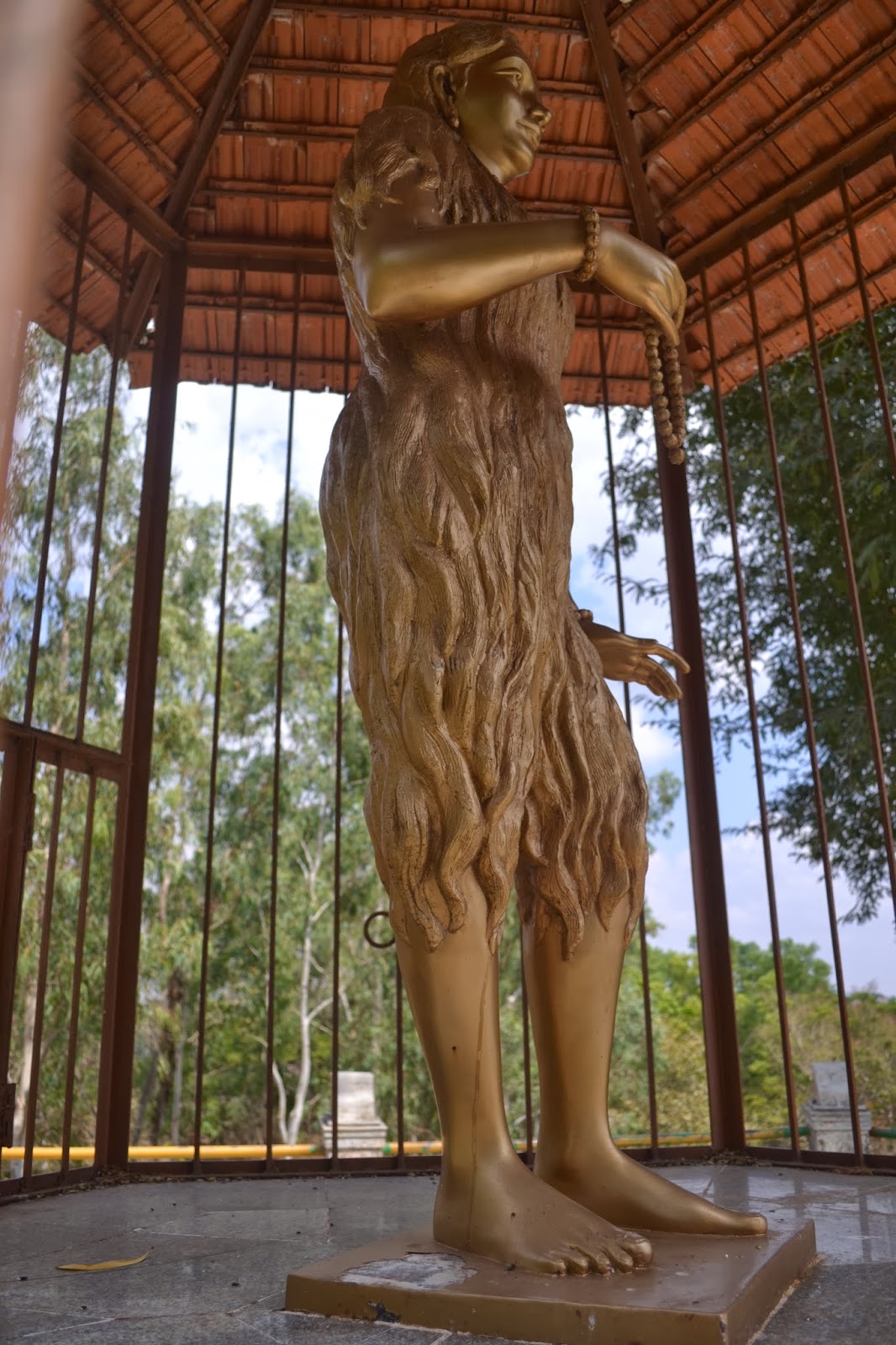
I have seen Akka Mahadevi’s pictures in small shops around Karnataka, a saintly naked woman covered in her own braids. I was quite intrigued but somehow didn’t pursue the matter. The other day I was at Haveri, a non-descript town, and was going through the sites and came across Akka Mahadevi. Her birth place happens to be about 70kms from Haveri which falls in Shimoga district (unlike what is mentioned in websites, you take a bus to Shiralkoppa and then to Udugani -it is mentioned as Uduthadi in websites, but you ask locals they haven’t heard!!). The roads are narrow so it will take about three hours and above in bus. So here I was at the birthplace of Akka Mahadevi and staring at her golden painted statue on a hillock.

Akka Mahadevi was a 12th century bhakti movement saint and poet (essentially she wrote vachanas); you could see a comparison to Meera and Andal. Unfortunately though as is the case in India, the mediocre society has classified her into some narrow sects and has since appropriated her into a divine figure, intact with a temple. Veershaiva started with egalitarian intent is reduced to caste like sect called lingayats (hindu sect that bury their dead) and are a potent political force with superior intent in pecking order, just another instance of reducing everything to its mediocre base. 

Though I find these repulsive, the temple dedicated to her has uniqueness of being an all-woman affair. The deity, priest and managing committee are all woman!! Quite a respite from patriarchal expressions of religion, and the ensuing cringe. The story goes that the king of the region wanted to forcefully marry her, she in turn strips herself and walks off, never to wear cloths again!! If you can understand how primitive our society is, even now, in terms of traditions crushing individual freedom, then you will realise the significance of Akka Mahadevi. And that makes, arrogating her into divine fold, furthermore tragic. Shockingly the temple of Akka Mahadevi also doubles up as centre for blessing childless couple, with strategically placed cradle all decked up with baby toy. What can be more repulsive? A revolutionary woman like Akka Mahadevi reduced to conservative utilitarian conceptions of society that very carefully places itself in patriarchal norms. Final stroke of insult was that the deified Akka Mahadevi was in marble stone, as is the trend these days –gods as “pure white”, and decked in red saree.

I am without pride of caste
Without pride of resolute will am I.
I have cast away the arrogance of riches,
Of the pride of learning also I have none.
No manners of pride dare come near me,
For Thou hast blest me with Thy Grace
.

 I bought a book from the counter Akka Mahadevi Life And Vachana’s by Leela Devi Prasad, a badly translated thin book that shouldn’t cost 60R, and came across these lines “…but in her appearance, she was like any other woman. The society at large could not see her as any different for any woman of good character and high dignity, the identification was linked to her family. For her righteousness, her character and her husband’s identification was considered important….but Akka Mahadevi explains her relationship in totally way. A woman’s spiritual attainment need to be linked with anything else excepting her own spiritual power…thus Akka was born a woman in some respects but she matched man in many ways”. I doubt whether Akka Mahadevi was trying to match men, as is being interpreted, because that will be accepting patriarchy as reference point. The pointers of packaging Akka to the modern world seems to be hinged on these lines, as I understand from my observations. I feel quite sorry for this misuse and lodge my strong protest. I also want to know during these period women of lower sections who may not be wearing proper cloths were “woman of good character and high dignity”? It seems the purity brigade has taken over the legacy of Akka Mahadevi. I am reminded of Bharatnatyam, essentially a devadasi dance form that is now completely appropriated by temple squatters and stultified as their divine niche.       

 Akka Mahadevi used her spiritual strength to revolt against social system, her presence steadfastly challenged the patriarchy and ordained place of woman in society. She rose above these; it is no coincidence that she sought blessings of saint Basava, a social reformer and not some temple squatter. She declared herself to be married to the god (in this case Mallikarjuna, a form of Shiva) thus challenging the whole conception of ritual religion. Her actions questioned woman as essential family embellishment and regressive values so derived. She walked naked to demolish the myth of woman as centre of societal pride and her body as arbitration of cultural references. 

To the shameless girl
Wearing the white Jasmine Lord’s
Light of morning,
You fool,
Where’s the need for cover and jewel?
 
She strode her own path and my hunch is that she put up the façade of ‘married to the god’ as a fence against the overwhelmingly conservative society; she used bhakti movement to assert herself. It is a denial rather than superior assertion. It also not a coincidence that among common people –though Akka is sanskritised and sought to be purified, is essentially a representation of female power.  

Oh hunger stay, stay
Oh desire stay, stay
Oh sleep stay, stay
Oh anger stay, stay
Oh attachment stay, stay
Oh greed stay, stay
Oh pride stay, stay
Oh jealous stay, stay
I am carrying a letter to the god.
   
Akka Mahadevi remains a definitive reference for female rebellion but also an important figure in the anti-Brahminical and anti-caste movement that thrived for just society about 800years back. She chose to wander naked, unmarried and unescorted by male. She remained independent from male domination. She did not rely on guidance from any male figures. Traditionally, it was believed that only ‘high caste’ men were able to become renouncers and Hindu society identified women with family and sexual pleasures, and thus were not seen to possess the ability to become ascetics. She rejected these traditional roles of men and women and strove to present the independent strength of the female saint.

As long as woman is woman, then
A man defiles her;
As long as man is man,
A woman defiles him.
When the mind’s taint is gone, is there room for the body’s taint?...

Sunlight made visible
(English version by A. K. Ramanujan)


Sunlight made visible
the whole length of sky,
movement of wind,
leaf, flower, all six colours
on tree, bush and creeper:
                        all this
is the day’s worship.
The light of moon, star and fire,
lightnings and all things
that go by the name of light
are the night’s worship.
                  Night and day
                  in your worship
                  I forget myself
O lord white as jasmine.

Monkey on monkeyman's stick

     Monkey on monkeyman's stick
     puppet at the end of a string

I've played as you've played
I've spoken as you've told me
I've been as you let me be

     O engineer of the world
     lord white as jasmine

     I've run
     till you cried halt.

People, male and female,

People,
male and female,
blush when a cloth covering their shame
comes loose
               When the lord of lives
lives drowned without a face
in the world, how can you be modest?

When all the world is the eye of the lord,
onlooking everywhere, what can you
cover and conceal?

The lure of miniature elephants: I am quite besotted to elephants wherever I travel I keep an eye open for miniature elephants. Over the years I have a fair collection, the picture herein is only a part. From Kashmiri paper mache to Pakistani onyx to Jabalpur marbles to Karnataka sandalwood to Bidari to Rajasthani….