Saturday, February 15, 2014

The Indian Spot billed Duck

 A rather common bird in the water bodies across the country, the male has a red spot on the base of the bill hence the name. 

Akka Mahadevi, an enigmatic woman

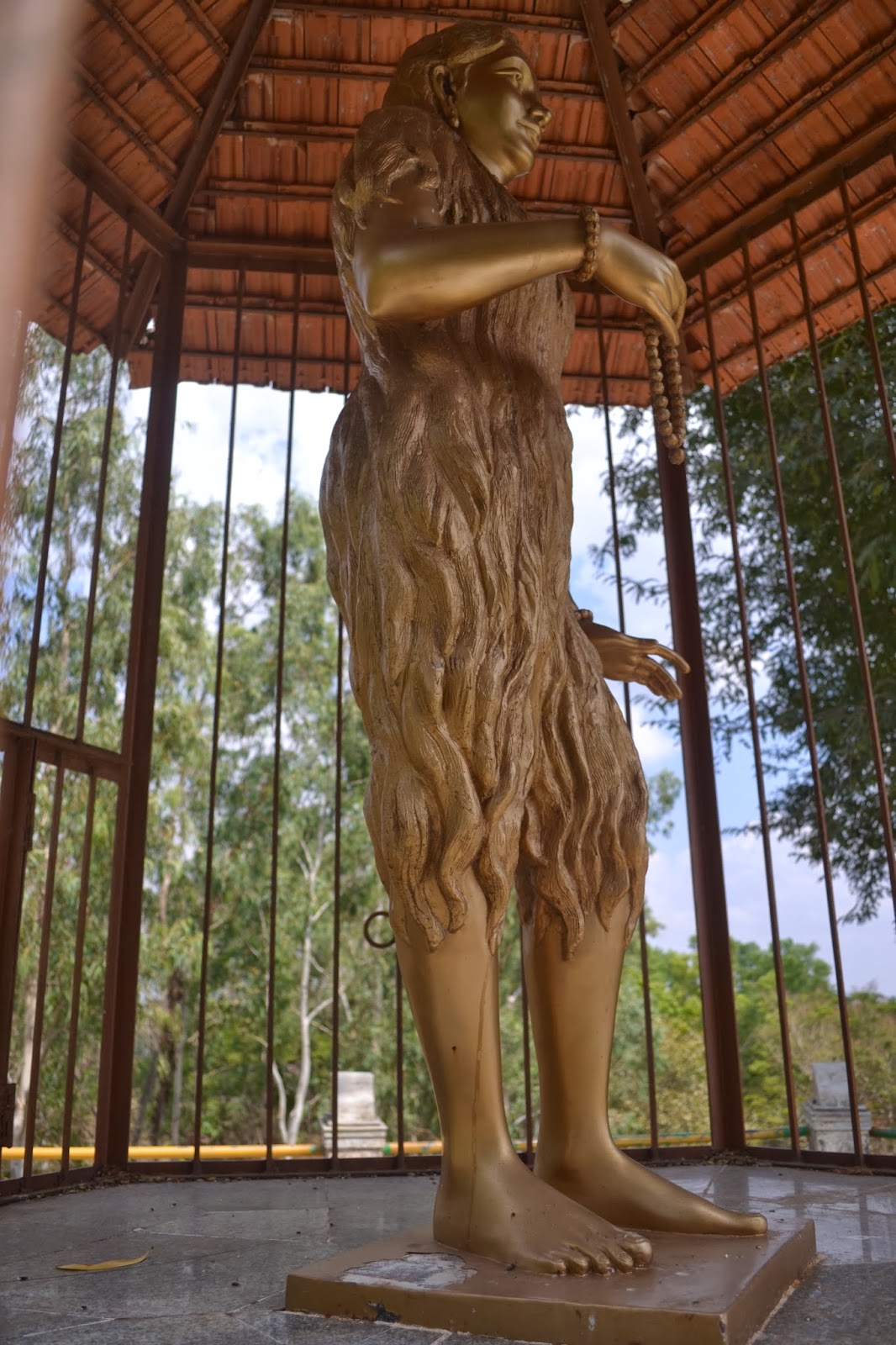
I have seen Akka Mahadevi’s pictures in small shops around Karnataka, a saintly naked woman covered in her own braids. I was quite intrigued but somehow didn’t pursue the matter. The other day I was at Haveri, a non-descript town, and was going through the sites and came across Akka Mahadevi. Her birth place happens to be about 70kms from Haveri which falls in Shimoga district (unlike what is mentioned in websites, you take a bus to Shiralkoppa and then to Udugani -it is mentioned as Uduthadi in websites, but you ask locals they haven’t heard!!). The roads are narrow so it will take about three hours and above in bus. So here I was at the birthplace of Akka Mahadevi and staring at her golden painted statue on a hillock.

Akka Mahadevi was a 12th century bhakti movement saint and poet (essentially she wrote vachanas); you could see a comparison to Meera and Andal. Unfortunately though as is the case in India, the mediocre society has classified her into some narrow sects and has since appropriated her into a divine figure, intact with a temple. Veershaiva started with egalitarian intent is reduced to caste like sect called lingayats (hindu sect that bury their dead) and are a potent political force with superior intent in pecking order, just another instance of reducing everything to its mediocre base. 

Though I find these repulsive, the temple dedicated to her has uniqueness of being an all-woman affair. The deity, priest and managing committee are all woman!! Quite a respite from patriarchal expressions of religion, and the ensuing cringe. The story goes that the king of the region wanted to forcefully marry her, she in turn strips herself and walks off, never to wear cloths again!! If you can understand how primitive our society is, even now, in terms of traditions crushing individual freedom, then you will realise the significance of Akka Mahadevi. And that makes, arrogating her into divine fold, furthermore tragic. Shockingly the temple of Akka Mahadevi also doubles up as centre for blessing childless couple, with strategically placed cradle all decked up with baby toy. What can be more repulsive? A revolutionary woman like Akka Mahadevi reduced to conservative utilitarian conceptions of society that very carefully places itself in patriarchal norms. Final stroke of insult was that the deified Akka Mahadevi was in marble stone, as is the trend these days –gods as “pure white”, and decked in red saree.

I am without pride of caste
Without pride of resolute will am I.
I have cast away the arrogance of riches,
Of the pride of learning also I have none.
No manners of pride dare come near me,
For Thou hast blest me with Thy Grace
.

 I bought a book from the counter Akka Mahadevi Life And Vachana’s by Leela Devi Prasad, a badly translated thin book that shouldn’t cost 60R, and came across these lines “…but in her appearance, she was like any other woman. The society at large could not see her as any different for any woman of good character and high dignity, the identification was linked to her family. For her righteousness, her character and her husband’s identification was considered important….but Akka Mahadevi explains her relationship in totally way. A woman’s spiritual attainment need to be linked with anything else excepting her own spiritual power…thus Akka was born a woman in some respects but she matched man in many ways”. I doubt whether Akka Mahadevi was trying to match men, as is being interpreted, because that will be accepting patriarchy as reference point. The pointers of packaging Akka to the modern world seems to be hinged on these lines, as I understand from my observations. I feel quite sorry for this misuse and lodge my strong protest. I also want to know during these period women of lower sections who may not be wearing proper cloths were “woman of good character and high dignity”? It seems the purity brigade has taken over the legacy of Akka Mahadevi. I am reminded of Bharatnatyam, essentially a devadasi dance form that is now completely appropriated by temple squatters and stultified as their divine niche.       

 Akka Mahadevi used her spiritual strength to revolt against social system, her presence steadfastly challenged the patriarchy and ordained place of woman in society. She rose above these; it is no coincidence that she sought blessings of saint Basava, a social reformer and not some temple squatter. She declared herself to be married to the god (in this case Mallikarjuna, a form of Shiva) thus challenging the whole conception of ritual religion. Her actions questioned woman as essential family embellishment and regressive values so derived. She walked naked to demolish the myth of woman as centre of societal pride and her body as arbitration of cultural references. 

To the shameless girl
Wearing the white Jasmine Lord’s
Light of morning,
You fool,
Where’s the need for cover and jewel?
 
She strode her own path and my hunch is that she put up the façade of ‘married to the god’ as a fence against the overwhelmingly conservative society; she used bhakti movement to assert herself. It is a denial rather than superior assertion. It also not a coincidence that among common people –though Akka is sanskritised and sought to be purified, is essentially a representation of female power.  

Oh hunger stay, stay
Oh desire stay, stay
Oh sleep stay, stay
Oh anger stay, stay
Oh attachment stay, stay
Oh greed stay, stay
Oh pride stay, stay
Oh jealous stay, stay
I am carrying a letter to the god.
   
Akka Mahadevi remains a definitive reference for female rebellion but also an important figure in the anti-Brahminical and anti-caste movement that thrived for just society about 800years back. She chose to wander naked, unmarried and unescorted by male. She remained independent from male domination. She did not rely on guidance from any male figures. Traditionally, it was believed that only ‘high caste’ men were able to become renouncers and Hindu society identified women with family and sexual pleasures, and thus were not seen to possess the ability to become ascetics. She rejected these traditional roles of men and women and strove to present the independent strength of the female saint.

As long as woman is woman, then
A man defiles her;
As long as man is man,
A woman defiles him.
When the mind’s taint is gone, is there room for the body’s taint?...

Sunlight made visible
(English version by A. K. Ramanujan)


Sunlight made visible
the whole length of sky,
movement of wind,
leaf, flower, all six colours
on tree, bush and creeper:
                        all this
is the day’s worship.
The light of moon, star and fire,
lightnings and all things
that go by the name of light
are the night’s worship.
                  Night and day
                  in your worship
                  I forget myself
O lord white as jasmine.

Monkey on monkeyman's stick

     Monkey on monkeyman's stick
     puppet at the end of a string

I've played as you've played
I've spoken as you've told me
I've been as you let me be

     O engineer of the world
     lord white as jasmine

     I've run
     till you cried halt.

People, male and female,

People,
male and female,
blush when a cloth covering their shame
comes loose
               When the lord of lives
lives drowned without a face
in the world, how can you be modest?

When all the world is the eye of the lord,
onlooking everywhere, what can you
cover and conceal?

The lure of miniature elephants: I am quite besotted to elephants wherever I travel I keep an eye open for miniature elephants. Over the years I have a fair collection, the picture herein is only a part. From Kashmiri paper mache to Pakistani onyx to Jabalpur marbles to Karnataka sandalwood to Bidari to Rajasthani….  


Tuesday, January 28, 2014

Watch those birdy legs!!

 To shoot a Common Redshank with a 70-300mm is a very difficult proposition, the bird is quite alert and wary not only that he creates a ruckus if seen and the sharp alarm call is enough for en mass exodus of the flock. Ohmygodwearebeingattacked…Ohmygodwearebeingattacked…spread the word. Its irritation value is similar to Lapwing. They have keen eyes and locate the prey that includes little fishes, molluscs, crustaceans so on, unlike many waders. So I hid myself behind an elevated sand dune along the water body and wait for him to amble by. Sure he did and so some great pictures.  
    
Common Redshank (Tringa tetanus) is a migrant from Europe and upper Himalayas, wintering in the plains of Indian subcontinent. The distinctive feature of this bird is their bright orange-red legs, they also have a medium-length bill with an orange base to match.

The tradition of conserving water: water is the most precious commodity in desert and the people of state of Rajasthan have some very innovative ways of conserving water. I was at Chand Baori in Abhaneri village that lies between Bharatpur and Jaipur near Dausa. It’s about 2-3 hours on bus from Bharatpur side while about 2hours from Jaipur, and about 10km inside from the highway. Baori or bavdi is a stepwell, Chand Baori was built during 8-9th century (since I have no concern for kings and dynasties therefore I don’t mention it, further when you say it was built by so and so king, the reality is it was not built by him, it was his property but the structure was built by the artisans who were talented but remain unknown, who made it happen. Reference to king and dynasties is skewed history, and reflects feudal mind).
 
Chand Baori is a four sided tiered carved stone stepwell that is about 100ft deep, three sides have 3500 steps arranged in a zigzag manner creating a visually spectacular image, Eschersque effect (after MC Escher 1898-1972, known for mathematically inspired work, he created art with polygons or regular shapes such as triangles, squares, and hexagons). The exquisite creation looks anything but a well, it not only served as reservoirs to store water for summers but also was centre for social gathering and cultural events as the temperature here was much lower than the surrounding. While one side is kind of a temple with spaces for cultural programs, the steps also converts to places to sit. The pavilions have aesthetic carvings and sculptures, and stage for performance art. Chand Baori is also the site for many movies, including, the popular Hollywood movie The Dark Knight Rises.  

Other famous step wells include Adalaj Vav (near Ahmedabad), Rani ki ji Baori (near Bundi Rajasthan), Agrasen ki Baoli (in Delhi).

A day later I was in Alwar, and had plans to visit Tarun Bharat Sangh (TBS), an NGO initiated by ‘waterman’ Rajendra Singh, that sought to revive traditional water harvesting and conservation methods. Over the years they have been immensely successful, even reviving dead rivers.  TBS is about 2hours from Alwar city, the route passes through the famous Sariska Tiger sanctuary. The volunteer at the TBS was quite an enthusiastic fellow, who, as is the tradition around here, asked whether I had my breakfast. I had forgotten about it so was enthused, there is a common eating place, meant for students and researchers as well as visitors. Food was basic but tasty. Later I was shown around, they have created a Baori in the vicinity as also an Anicut, all these were explained to me. TBS has been instrumental in reviving Johads (water storage tanks) or earthen check dams a traditional method to catch and conserve rainwater, leading to improved percolation and groundwater recharge. There is a small library here on these matters. The volunteer explained to me about the miracle of converting deserts into forests, indeed the place has lot many bird species including an Asian grey hornbill that made its presence felt from the top of the tree under which we sat!!  Their activities have brought water back to more than 1,000 villages – spread over 6500 sq. km, and revived 5 rivers in Rajasthan – Arvari, Ruparel, Sarsa, Bhagani and Jahajwali. River Ruparel, that went dead, has started flowing again after a span of three decades. River Arvari which became perennial by 1995, was awarded the `International River Prize’. There is a map depicting all these rivers which was shown to me.  

Rajendra Singh is quite an inspirational figure, also called Johadwala Baba (bearded man of check dams), apart from water harvesting initiatives he has been actively involved in documentation of medicinal plants and their uses in traditional medicine. As their website mentions “Rajendra Singh also led a campaign and a struggle against the destructive consequences of mining in the Aravali hills. The Union Ministry of Environment and Forests, on the basis of a Supreme Court Order of 1991, issued orders banning mining in the Aravali Hills system. With a view to ensuring that this order was observed, Rajendra Singh launched a movement to mobilise people He also organised an Aravali Bachao Yatra from Himmatnagar in Gujarat to Delhi. Thousands of people participated in this yatra. As a consequence of this mobilisation, the Rajasthan Govt. closed nearly one thousand mines in the whole of Rajasthan, 470 of which were in and around Sariska. The workers rendered jobless due to the closure of the mines were rehabilitated through water and forest conservation activities and rural development, like animal husbandry, agriculture and through different types of employment generation activities initiated by Tarun Bharat Sangh”. 

Feted nationally and internationally Rajendra Singh is also been awarded prestigious Magsaysay award for his social works. Truly an amazing man. 

From my scribble pad…


The resume reader
The stamp size shot doesn’t show the anguish
the uncertain future and a terrible forecast.
The dates don’t show the days
of jovial waywardness, and
silences of the moment.
The qualification doesn’t tell the lessons learnt
and unlearnt, the talent of the lane.
The fake formalities hide a sinister plot
of what is accepted and demanded.
The light drone of air conditioner
doesn’t conceal the beats the little heart endures
and waits for flash of flight
to the next branch
up and away.


Monday, January 20, 2014

Desert Wheatear at Sambhar salt lake

 On a chilly morning of early January when the temperature was dipping to new lows I caught an early morning bus to Sambhar salt lake from Jaipur. Though my watch indicated 6am but it seems midnight, pitch dark made sinister by drooling fog, a rickety two hour ride and I was in Sambhar town. The fog had cleared and behold, what a sunny day. Few minutes’ walk, you pass salt museum which looks like a mausoleum, and enter open ground that stretch into miles and miles. It is not like desert sand of Jaisalmer but firm dry ground, a mix of maroon and white that cracks as you walk, white made brighter by the morning sun, no living thing nearby not even a shrub it was absolutely barren. It is as if you are on a beach and the ocean has retreated to where the eye couldn’t see. Strange mix of chilly wind, warm sun and blinding whiteness that stretched like a surreal canvas that is perfectly plain. For a moment I was reminded of Bergman’s movie and the old man’s dream. It was so exhilarating that I walk few kilometers in, till the vague feeling get confirming that I am loosing sense of direction. After standing still for few minute, where you truly are middle of nowhere –it could even be some other planet, I made a hasty retreat. It was one of its kind experiences. I strongly suggest it. 


I hear whistle of an approaching train and wait…and wait. No train and you think the surreal surrounding has started to play its trick in your mind. O my god its happening I am going mad! You forget about the train and look at the horizon, its shimmering you think its water and expect the flamingoes to emerge but realize it’s a mirage, alright I had enough of this. As I was walking back I hear a distinct noise of train, I tell myself I am not going to fall for it this time, and keep walking. The lumbering train though real looks unbelievable in the surrounding as it cuts through the lake like an gigantic millipede.  
  
The lake, that has a circumference of about 100Km, is completely dry with little patches where the salt is cultivated, pool of brine could be seen, another patch had gotten maroon as the water had evaporated leaving last hint of moisture. Then the incredible sight of children playing cricket, you hit the ball and the ball keeps rolling as there is nothing to stop!! It possibly is the best ground for sports; I thought they should be playing football than the lazy man’s game and waste their health and keenness. No game dulls the sense as cricket, quite appropriately it is doing well in Indian subcontinent. 

There is narrow gauge line that criss cross the lake meant to carry the salt from the pans to processing unit. The salt wagon as they pass make hell of a noise, and you think it may topple down. The miracle of momentum pushes it further from disaster and so it goes on. It though is a riveting sight. Salt from the lake is being produced for more than 2500 years, so much salt is produced even now that Rajasthan is the third largest producer of salt because of Sambhar salt. Nearby is also the sight for largest solar based power project in the world. Bravo to that!!
There is a PIL submitted in the court that says the lake “has a great potential to support large population of flamingos, other water birds and faunal diversity. Hence, it requires proper focus and attention for its conservation. This has become all the more necessary because Sambhar Lake is facing serious threats due to large scale top soil removal by private salt industries, heavy vehicular trespass by villagers, small dam construction in the catchment areas restricting the water supply of the lake, mushrooming of private salt industries on the northern belt of the lake…”

It was while I was walking along the track on the way back that this bird makes his bold move and land right in front of me. He stretches his head out to look at something, completely ignoring me. The Desert Wheatears is quite a charmer and I was locked in for next half an hour or so. Desert Wheatear (Oenanthe deserti) is a winter migrant from central Asia and could be seen in the patch from Rajasthan to Gujarat.

Later as I was strolling along the meandering alleys of the town to anchor for breakfast, least expecting anything proper (as mentioned earlier breakfast in north India is always a horrible experience mostly you have to go without or maybe munch some fruits) people asked whether some ‘shooting’ was to happen? Interacting with them I gathered that Sambhar town as well as the lake has seen some popular movies being shot. Indeed the narrow alleys were converted into Chandni Chowk for the hindi movie Delhi 6!! I just couldn’t believe that a rather quite town could be converted into noisy crowded old delhi but yes when you look around there is essential framework. I made a mental note to watch the movie, since it is difficult to watch complete movies in TV, atleast the scenes. On a lighter note there were too many people asking about impending shooting that I succumbed to the temptation ‘yes yes. I cannot reveal it now’. ‘Who is the hero?’ was a query that hit right where it hurt. Gosh I couldn’t recollect names of any of recent Hindi movie actors!! Few people throng around me as i sipped the sugary tea. Later someone with a glint in his eyes said ‘it must be bike ad’. ‘Sure it is…how did you know?...I cannot reveal much as there is too much competition!’. I guess cooking good stories does compensate for breakfast. I had my revenge!    

From the scribble pad..

To see the nothing

Every moment nature reveals a mystery. 
A tale to tell.
An anecdote to share.
The startling breeze on a silent night
drops in a word of ageless sight,
Little flutters flaps in a sentence of earnest on a bright day,
Knits paragraph of diligence with tireless eight legs,
Slithers on the trail as a phrase of insight,
Croaks from pond the moral of wild,
Spreads its bloom as colorful dots of wisdom,
A moment here is never too short.

I, the silly, miss it all the while.
Look at the dry leaf and speculate the tree.
Isn’t that a flycatcher or is it a warbler?
Which spider specie is that, I consider?
Ah the snake, reckon is poisonous.
The irritant frogs.
And wild flowers, just the right one to shoot.

Or maybe there is nothing.
The zephyr is a moment in time.
Sound is to listen.
Sight is see. 
Mind a thought.